Famous Indian dishes: what to order on your first trip
You've just sat down at a restaurant in Delhi, the waiter has placed a laminated menu the size of a small newspaper in front of you, and your travel companion has already asked the question you've been trying not to ask: "So…
You've just sat down at a restaurant in Delhi, the waiter has placed a laminated menu the size of a small newspaper in front of you, and your travel companion has already asked the question you've been trying not to ask: "So... what should we actually order?" If you've only ever eaten Indian food abroad, the menu in India will look both familiar and slightly foreign — the same dish names, sure, but with regional variations, unfamiliar preparations, and a spice vocabulary that doesn't quite map onto anything you grew up with. Here's the reassuring part: you can't really go wrong. Indian cuisine is built around hospitality, and the kitchen genuinely wants you to enjoy the meal. The trick is knowing a handful of dishes well enough to anchor yourself, and understanding the logic behind why the menu looks the way it does.
A quick mental reset before you start ordering: Indian food is not, on the whole, the "burn-your-face-off" experience your most dramatic friend has probably described. Heat varies enormously by region, dish, and household, and a great deal of the country's most beloved cooking — dal, many biryanis, most thalis, a long list of sweets — is either mild or sweet. What Indian cooking is, consistently, is layered: spice blends built from many ingredients rather than one source of heat. A single curry might carry cumin, coriander, turmeric, ginger, garlic, garam masala, and chili, none of which dominates if the dish is well made.
India doesn't have one cuisine. It has twenty-plus regional traditions, and each one quietly rewrites what you thought you knew about Indian food.
North vs. South: Navigating Regional Culinary Traditions
The single most useful thing you can learn before your first meal in India is the broad north-south split, because it explains almost every dish on every menu you'll encounter.
North Indian cuisine is wheat-based and dairy-rich. Staples include roti, naan, paratha, and kulcha, paired with gravies built on tomatoes, onions, cream, ghee, and paneer. Mughal culinary influence runs deep here, which is why you'll see richer, milder curries — Butter Chicken, Paneer Tikka Masala, Dal Makhani — that often rely on slow-cooked tomato-cream bases rather than aggressive heat. If the restaurant abroad you frequented back home was a British-Indian takeaway or a Punjabi-style spot, the food you'll eat in Delhi, Amritsar, or Lucknow will feel like meeting an old friend with a much more interesting wardrobe.
South Indian cuisine flips the script. Staples are rice and lentils rather than wheat, and the flavor profile leans on coconut, tamarind, curry leaves, mustard seeds, and dried red chilies. Dishes like Masala Dosa — a fermented crepe of rice batter and black lentils, crisped on a griddle and stuffed with spiced potatoes — come with sambar (a lentil-vegetable stew) and coconut chutney. Idli (steamed rice-lentil cakes) and vada (savory fried donuts) anchor breakfast across Tamil Nadu, Karnataka, Andhra Pradesh, and Kerala. On the coast, expect coconut-rich fish curries and seafood preparations that have little in common with the "curry" you've been imagining.
A practical tip: when you sit down in a restaurant, glance at the menu's regional marker or ask, "Is this more North Indian or South Indian?" The answer will tell you whether to expect breads-and-gravy or rice-and-coconut, and it will save you from the mild shock of ordering what you thought was a familiar curry and receiving something quite different.
One more thing worth knowing before you go: India has a remarkably high proportion of vegetarian dishes, and many restaurants — especially in the South and in Gujarat — serve exclusively vegetarian food. That's not a restriction to navigate; it's an invitation into one of the world's most sophisticated vegetarian traditions. Paneer, lentils, chickpeas, potatoes, cauliflower, okra, eggplant, and a long list of greens are handled with the same seriousness that meat receives elsewhere.
The Story Behind Iconic Staples: Butter Chicken and Biryani
Two dishes will follow you across India, appearing on nearly every restaurant menu in some form: Butter Chicken and Biryani. Understanding where they come from makes ordering them a lot more interesting.
Butter Chicken — or Murgh Makhani — was invented in Delhi in the 1950s at Moti Mahal, a restaurant in Daryaganj. The kitchen had been serving tandoori chicken — chicken marinated in yogurt and spices, roasted in a clay oven — and to use up leftover pieces that dried out overnight, the cooks simmered them in a velvety tomato gravy enriched with butter and cream. The result became so popular that it spawned an entire category of creamy tomato-based curries, including the globally familiar Paneer Tikka Masala. Today, Butter Chicken is a benchmark: a well-executed version should be smoky, mildly sweet, tomato-bright, and gently spiced rather than fiery.
Biryani is older, more contested, and considerably more regional. It's a layered rice dish, slow-cooked with spices and either meat or vegetables, in which partially cooked rice and a marinated protein are sealed together in a pot and finished on a low flame — a technique called dum. The Hyderabadi version, refined in the kitchens of the Nizams, is the most internationally recognized, with its saffron-tinted rice, tender meat (often goat or chicken), and the subtle fragrance of rose water or kewra. Lucknowi (Awadhi) biryani is more delicate, with milder spices and a stronger focus on the fragrance of the rice itself. Kolkata's biryani is famous for adding a boiled egg and potato, a combination that's now a beloved signature.
| Aspect | Butter Chicken (Murgh Makhani) | Hyderabadi Biryani |
|---|---|---|
| Origin | Delhi, 1950s, Moti Mahal restaurant | Hyderabad, tradition refined under the Nizams |
| Primary grain / base | Naan, roti, or rice, served alongside | Basmati rice is the dish itself |
| Flavor profile | Creamy, mildly spiced, tomato-bright, smoky | Fragrant, layered, moderately spiced, saffron-kissed |
| Key ingredients | Tandoori chicken, butter, tomato, cream, kasuri methi | Basmati rice, meat or vegetables, fried onions, saffron, whole spices |
| Best for first-timers | An almost universally loved entry dish | A more complex, deeply aromatic experience |
A practical note: if a menu lists "Chicken Biryani" without specifying style, it's usually safe to assume a Hyderabadi-style preparation in most regions. Ask anyway — most kitchens are happy to tell you.
Mastering the Art of Chaat: India's Vibrant Street Food Culture
No exploration of Indian cuisine is complete without stepping into the world of chaat — a category of savory street food snacks that delivers the full sensory vocabulary of Indian cooking in a single bite: sweet, spicy, tangy, crunchy, and cool, often at the same time.
Chaat isn't a single dish. It's a family. Some of the most common members you'll encounter:
- Pani Puri / Golgappa — small hollow crisp puris filled with spiced water (pani), tamarind chutney, chili, and mashed potato or chickpea. You eat the entire thing in one mouthful.
- Bhel Puri — puffed rice, sev (crispy chickpea flour noodles), onions, tomatoes, and tamarind-mint chutney, tossed together. Mumbai's signature beach snack.
- Aloo Tikki — pan-fried potato patties, often served with yogurt and chutneys. A North Indian classic.
- Sev Puri — flat crisp discs topped with onion, tomato, chutneys, yogurt, and sev. Essentially a deconstructed pani puri.
- Papdi Chaat — crisp wafers layered with yogurt, tamarind, and mint chutneys, topped with sev.
The flavors are built on contrast. A bite of bhel puri hits your tongue with the crunch of puffed rice, the cool of onion, the tang of tamarind, the heat of green chili, and the herbal lift of fresh coriander — sometimes in the same second. This is the cuisine that Indian grandmothers describe as "chatpata" — a word you won't find in standard dictionaries, meaning a simultaneous sensation of spicy, tangy, and exciting.
A word on eating chaat safely as a foreigner: it's some of the most rewarding food in India, but it does reward a little attention. Look for vendors with high customer turnover — a stall that sells out by early evening is generally safer than one where the same trays have been sitting since morning. Watch for freshly fried elements, steaming-hot preparations, and clean water for the chutneys. When in doubt, follow the crowd: long queues of locals at a chaat stall are usually a good sign. Wash your hands before eating, or use the tissue paper most vendors hand you. And don't drink tap water — bottled or filtered only.
Dining Etiquette and Cultural Norms for Foreign Travelers
Knowing what to order is half the experience. Knowing how to eat it well — and respectfully — is the other half.
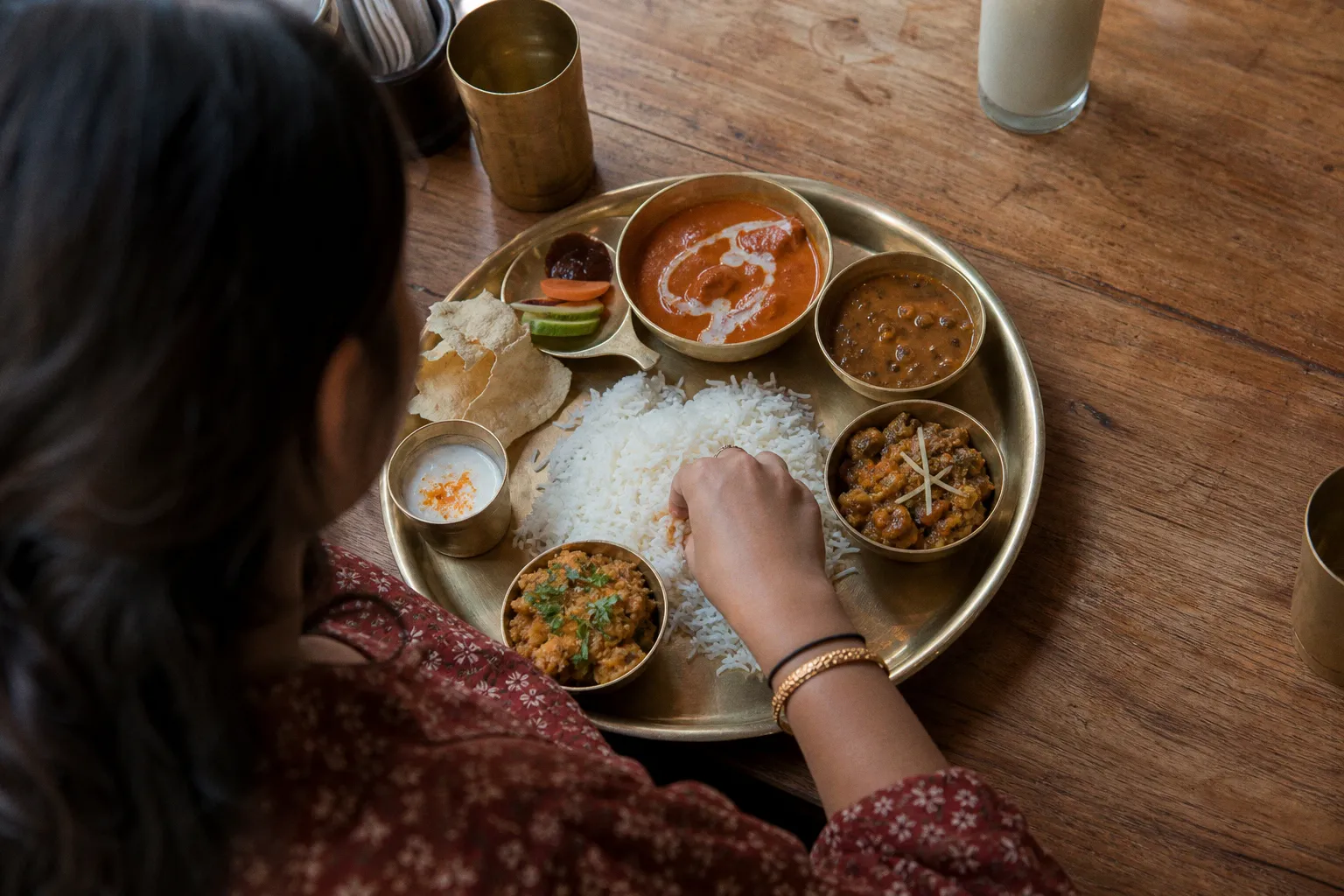
The first thing most foreigners encounter is the hand-eating question. In traditional Indian dining, food is eaten with the right hand. The left hand is traditionally considered reserved for personal hygiene, so using it to pass food or touch shared plates is a small but noticeable breach of etiquette. This isn't a rule to fear — it's a long-standing practice tied to the way food is served and shared. In homes and many traditional restaurants, you'll be served rice and curry on a banana leaf or a steel thali, and you'll use the fingertips of your right hand to mix and lift the food.
In tourist restaurants and most urban settings, cutlery is fully available, and no one will mind if you use a fork and spoon. But if you're sharing a meal with an Indian family, trying the hand method — using only the fingertips, not the whole palm, and using bread as a scoop — is a small gesture that signals respect and curiosity. It also genuinely changes the sensory experience: eating with your hands warms the food slightly and engages your sense of touch alongside taste, which is part of why the practice has endured for so long.
Eating with your hands isn't primitive. It's an ancient sensory tradition — and the moment you tear a piece of roti and scoop up a dal, you'll understand why it has never gone away.
A few other norms that smooth the experience:
- When offered more food, especially in someone's home, decline gently once, then accept a small portion on the second offer. The first refusal is politeness; the second offer is genuine. Refusing outright can read as rejecting the hospitality itself.
- Praising the food is a sincere compliment. "This is delicious" goes a long way — to the cook, to the host, and to the cultural exchange you're having.
- At traditional meals, dishes are often