Order Safe Street Food in Delhi Without Getting Sick
The sizzle of an aloo tikki on a hot tawa, the silky thread of a jalebi lifted out of oil, the metallic wash of cumin steam rolling off a karahi — Delhi's street-food choreography has a tempo that…
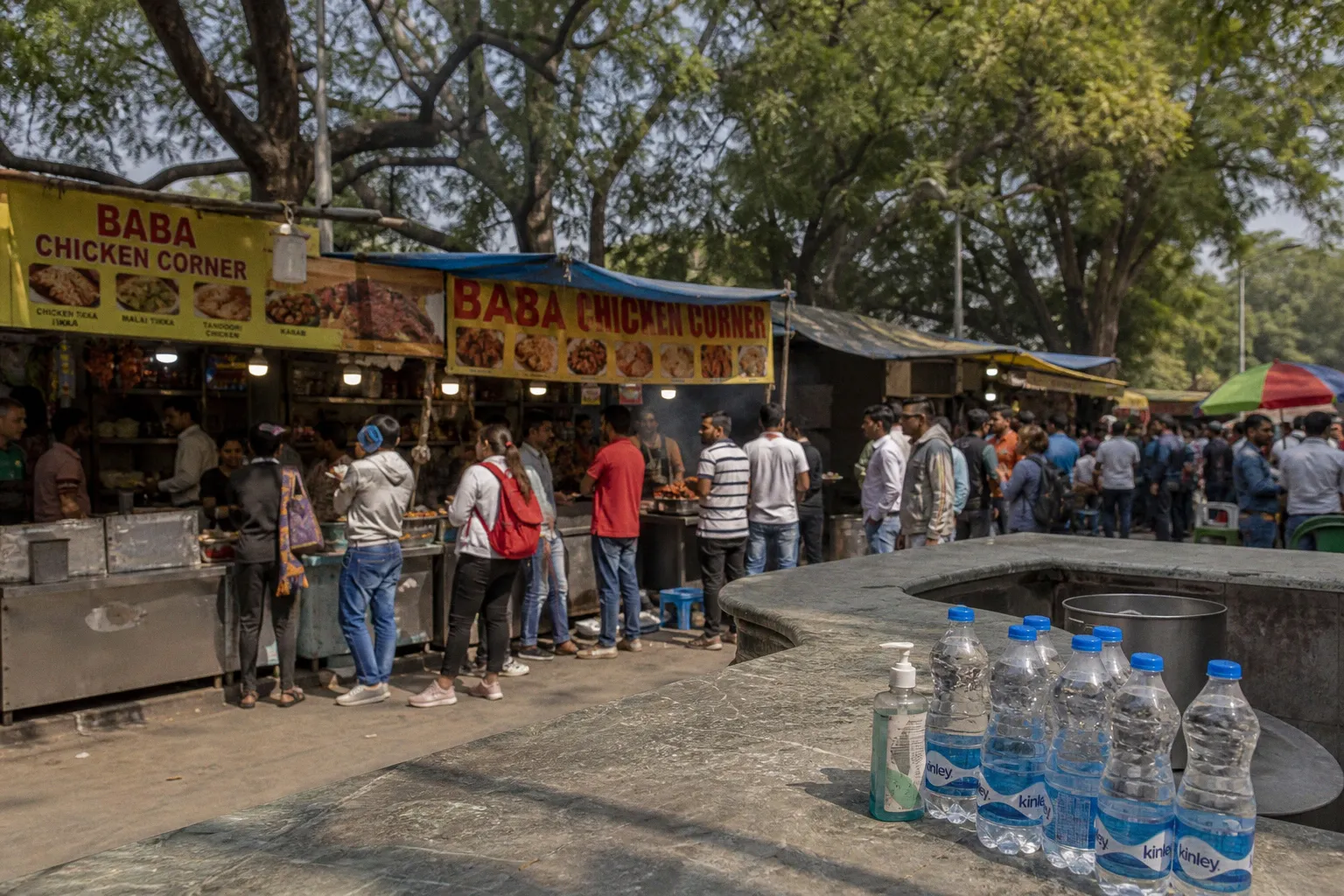
The sizzle of an aloo tikki on a hot tawa, the silky thread of a jalebi lifted out of oil, the metallic wash of cumin steam rolling off a karahi — Delhi's street-food choreography has a tempo that takes visitors a day or two to feel, and tens of thousands of stalls feed the capital every single day. The great majority of those meals end without incident, and the reason isn't some mysterious Delhiwali immunity. It's a small, learnable set of mechanics that locals apply without thinking, and that travel with anyone who spends an afternoon on them.
Five mechanisms, in the order your stomach actually encounters them: how to pick a stall, why heat is doing the disinfecting (and not the spice), where raw ingredients quietly add risk, the small ritual that makes hands-on dining safe, and the drinks that can undo your discipline if you don't know them. None of it is exotic. All of it sticks.
The High-Turnover Rule: Why a Crowded Stall Is Usually the Safer One
In Delhi, locals queue at specific stalls for reasons that have nothing to do with marketing. A constant flow of customers means the vendor is replenishing ingredients on a fast loop — fresh batter, fresh oil, fresh chutney every thirty to sixty minutes. Bacterial colonies in food do not need long to multiply at ambient temperature. Two to four hours of sitting is the window where risk compounds. A stall that runs through its inventory quickly never gives pathogens that lag time. The crowd is the indicator.
For related context, see The Rise Of App-First Gaming Culture: How Mobile Platforms Are Changing Entertainment.
For related context, see Ritesh Arora joins Cinepolis India as General Manager - Distribution.
Practical signals worth reading at a stall:
- A queue of locals — office workers, families returning from school runs, autorickshaw drivers on break. Tourist-only queues are a different signal: they often mean photo-friendly plating and ingredients that have been sitting under a heat lamp.
- Oil that visibly bubbles when new items drop in. Cool, still oil is oil that was heated hours ago.
- Steam still rising off the tawa when the food comes off. If the surface is hot enough to fog your eyeglasses, it has cooked whatever is on it within the last seconds.
- Vendor rhythm. The most experienced hands never stop working. A relaxed vendor with items piled beside the griddle is a vendor whose food has been waiting.
A useful mental exercise the moment you walk into a market: scan for the three or four stalls with the longest lines and walk straight to those. The rest of the geography is for day three, once you understand which vendors are pulling the morning rush and which are feeding the dinner lull.
The line at a busy aloo-tikki stall in Chandni Chowk can run fifteen minutes deep. Locals use that window to chat with the cousin beside them, while visitors often pull out their phones. A few minutes of people-watching, observing the vendor's practiced motions or the interactions of the regulars, is a fair use of that wait, and frankly a more reliable signal of stall quality than the most obsessive food blog could ever be: if the line is still there when you look up, you are in the right place.
Crowds are not a slow line at a museum — they are a clock. The faster a stall cycles its inventory, the harder it is for anything harmful to settle in.
Thermal Safety: Heat — Not Spice — Is the Disinfectant Working for You
Capsaicin does a lot of things to the human tongue and brain. Disinfecting your meal is not one of them. The reason a freshly fried paneer tikka is safe and a chilled paneer tikka from a buffet is not comes down to temperature, not flavor. Heat applied during cooking pushes the surface of food well past the threshold at which most of the troublesome organisms — E. coli, Salmonella, Staphylococcus aureus — are inactivated, a window starting around 75 °C for a few seconds. Boiling, deep-frying at 170 °C and above, tawa-grilling over a flame, and slow-simmering in a karahi all cross that line comfortably. Spice does not add to it.
This is good news, because virtually every iconic Delhi street dish is cooked-to-order, not held:
- Aloo tikki and chole: tikki is pan-fried on the spot, chole arrives boiling from a karahi that has been on the heat since morning.
- Chaat variants with hot components — bhalla, fried lentil dumplings soaked and topped warm; tikki chaat; papdi chaat assembled over a warm base.
- Momos, steamed in bamboo baskets or pan-fried.
- Kebabs and seekh, just off charcoal.
- Jalebi, dropped into hot oil and lifted out minutes later.
The one item that breaks the pattern is pani puri, also sold as gol gappa. The shells are fried hot — that part is safe. The water inside is the question. It is a spiced, mint–coriander–tamarind blend meant to be tossed and drunk in one quick motion. If the stall's water is replenished often (you will see the vendor refilling from a large container several times a day) and the line is brisk, you are usually fine. If the pot has been sitting in the shade all afternoon, skip and pick something hot instead.
A small, useful heuristic: if you can watch the food being cooked, you can trust the food. The theatre of the street is its own quality certification.
Your taste buds love the heat. Your gut keeps a separate ledger — and what it credits to it is the temperature of cooking, not the capsaicin on the tongue.
Raw Ingredients: Where the Risk Quietly Lives
The foods that are cooked on the street are usually safe precisely because they are cooked. The foods that get people sick at Indian street markets are almost always the ones that aren't — the fresh-looking salads, the glistening chutneys, the fruit chaat that has been on a tray since the lunch rush started. The reason is mechanical: anything raw has to be washed, and water on a Delhi street stall is not the water you would use at home.
Avoid, or approach with caution:
- Salads with cucumber, onion, or tomato wedges, often served as a side at roadside dhabas. They have been rinsed in tap water and sliced on a cutting board that has been used all morning.
- Chutneys that have been sitting out. Mint–coriander, tamarind–date, imli — these are the most common carriers. The surface looks fine. The microbiology is not.
- Peeled or cut fruit, including the oranges piled near railway stations and the watermelon cubes sold by weight in summer.
- Dahi (yogurt) served at ambient temperature, including the dahi bhalla in chaat, unless the stall is visibly busy and the dahi is from a fresh container.
- Ice from an unverified source — covered in the beverages section below.
Prefer, without overthinking:
- Cooked vegetable dishes, from aloo sabzi to chole.
- Fried items where you watched them drop into the oil.
- Chaat assembled on the spot, with components still warm.
- Anything where heat has done its work in front of you.
The mental filter is simple. Hot and freshly cooked is your default. Raw and cool requires a vendor you already trust, and that trust is earned over days, not minutes.
A quick-reference guide to common items:
| Order with confidence | Approach with caution |
|---|---|
| Aloo tikki (pan-fried on a hot tawa) | Raw cucumber or onion salad on the side |
| Chole, served hot from the karahi | Chutney sitting in an open steel pot |
| Jalebi, fried to order | Cut fruit or fruit chaat from a tray |
| Kabab just off charcoal | Untested lassi from a sidewalk stall |
| Masala chai from a busy tapri | Fresh sugarcane juice at a small stall |
This is not about suspicion of the cuisine. It is about recognizing that some ingredients, by their very nature, do not get the life-saving baptism of heat that others do.
Eating With Hands: The Small Hygiene Routine That Keeps Tradition Working
Delhi street food is overwhelmingly eaten by hand. Aloo tikki broken in two and pinched between the fingers. Chole scooped up with a piece of tandoori roti. Gol gappa popped in one decisive motion. It is one of the great pleasures of the city's food culture, and it comes with a small set of mechanics that locals already practice. Travelers can adopt them in a single afternoon and join in fully.
The right hand does the work; the left hand stays reserved. In a country where most people wash with water, separating the hands during eating keeps the food-handling hand consistent. Use the right for everything that touches your plate.
Wash before you sit down. Handwashing stations at street stalls are common — a small tap or a steel container with a ladle. If neither is available, an alcohol-based hand sanitizer with at least 60% alcohol is functionally equivalent for the surface-bacteria side of the equation. Apply a generous amount, rub it in for twenty seconds — including between the fingers and across the thumbs — and the surface hygiene is at parity with a freshly washed hand.
The sanitizer number matters. Anything labeled below 60% — "antibacterial," "moisturizing," the cheap bottles from airport kiosks — does not reliably inactivate the relevant pathogens at the volumes most people use. Look at the active ingredient panel. Alcohol denatured at 60% or higher is the threshold. Above 70% is better, with diminishing returns around 90%.
Plate and assembly-line hygiene. Most serious vendors use disposable paper or pressed-leaf plates. A banana-leaf plate, common in the south, has natural antimicrobial surface properties and is, if anything, more hygienic than plastic. If you want an extra barrier, fold a tissue and use it as the contact surface between your palm and the plate — the food itself stays untouched.
A small grace note: the morning or evening "I have just sanitized my hands" check before you sit down quickly becomes invisible. Within a day or two, it is no longer a ritual — it is just how you arrive at food. It is the price of admission to a world of flavor that is otherwise closed to the unprepared.
Beverages and Bottled Water: The Quiet Leak in Most Safety Plans
Most travelers who follow the food rules perfectly still end up with a bad day. The food was not the source — the drink was. Beverages deserve the same attention as the plate in front of you.
Bottled water. Buy sealed bottles only. Verify the seal — pull-tab intact, plastic shrink-wrap unbroken, brand labels consistent. Refilled bottles are a known category of street scam across South Asia, and the giveaway is the seal: stretched, creased, or otherwise looking like it has been opened and re-stuck. Avoid them. Use bottled water for brushing teeth if you want to be exhaustive; most travelers eventually relax on this point after a few days without incident, but the conservative call is bottled water all the way through.
Tea and coffee. Masala chai from a busy tapri is one of the safest drinks in Delhi. The brewing process is a five-minute boil in a heavy pot of water — that heat cycle sterilizes, and the constant refilling from a fresh batch means no standing water. Insist on a fresh pour; sitting chai that has cooled on the counter is not the same drink. Filter coffee from a South Indian stall in places like Karol Bagh is treated similarly — boiled milk, hot plate, careful brew.
Lassi. Skip the untested version. Dairy is one of the highest-risk surfaces in a humid climate, and the sweet lassi at a small stall may have been ladled from a container that has been open for hours. Trusted sweet shops — Nathu's in Chandni Chowk, Haldiram's anywhere — are safe choices because the volume clears stock quickly and prep is centralized. If you can't verify, skip.
Juice and shikanjvi. Sugarcane, orange, and mixed-fruit juices are popular at small stalls, especially in summer. The risk is the juicer and the water used to rinse the machine. Bottled or canned drinks — Coke, Limca, ThumsUp, Bisleri water — are essentially zero-risk because carbonation and sealed packaging handle preservation. Cold drinks in glass bottles from a shop fridge are also fine.
Ice. If you didn't see it come out of an industrial machine at a hotel or a chain restaurant, skip. Roadside stall ice is usually fine in winter when ambient temperatures slow microbial growth, but the marginal cost of skipping it on day one of your trip is zero. The thirst it quenches is not worth the gamble.
The principle that ties this whole section together is identical to the food section: anything that has been heated since it was last touched by a potentially contaminated surface is safe. Anything that has been sitting in contact with such a surface at ambient temperature is not, full stop.
Putting It Together
Five rules, in the order you encounter them. Pick a stall by the locals it attracts, not the photo it promises. Trust the food that is still steaming — heat did its work in front of you. Treat raw additions with the same suspicion you would any surface that has been rinsed in a non-potable context. Eat with your right hand, and arrive at the plate with sanitizer or water on it. Filter every drink through the same logic you filter the food.
None of these steps are interesting on their own. Together, they collapse the difference between tourist-eating and local-eating. After a day of practice, the queues stop being intimidating. The menus stop being intimidating. And the great, sprawling, tannin-rich street-food map of Old Delhi, the Civil Lines, the lanes around every metro station opens up to you in a way no guidebook can replicate.
That is the gift of this city's food culture. It was never really meant to be feared. It was meant to be eaten — in the right place, with the right hand, at the right moment. The mechanics are the map. The feast is the territory.