Indian street food in Mumbai: a quick 5-minute guide
Mumbai's street food operates on a compressed timeline. Foreign visitors who approach it without a working knowledge of the local system spend the first two days guessing — guessing which vendor to…
Mumbai's street food operates on a compressed timeline. Foreign visitors who approach it without a working knowledge of the local system spend the first two days guessing — guessing which vendor to trust, which batch is fresh, which price is correct, and which neighborhood hosts the item they actually want. The stalls operate on defined batch cycles, hygiene outcomes vary by vendor and by time of day, and the most iconic items carry price bands that shift by zone. This brief covers the operational reality of the system: what to order, where to find it, when to arrive, and how to minimize the gastrointestinal incidents that affect an estimated 30–60% of foreign visitors to South Asia during their first trip.
The city's food lanes — locally termed Khau Gallis — concentrate dozens of independent vendors within a 200-meter stretch. They are not markets, food courts, or restaurants. They are high-throughput, cash-only, single-purpose operations. A traveler who treats them as a system will eat well. A traveler who treats them as casual will likely consume an item past its safe window and spend the following 24 hours rehydrating.
Structure and operating model: what a Khau Galli actually is
A Khau Galli is a linear configuration of independent vendors selling specific items. Khau translates to food; Galli to lane. Each stall typically specializes in one to three items, executed repeatedly through the operating day. Vendors do not offer printed menus. Transactions take 30–90 seconds. The vendor produces the item, the customer pays in cash, and consumption occurs standing or on adjacent shared benches.
Three Khau Gallis dominate the foreign visitor's circuit:
| Location | Operating character | Core items |
|---|---|---|
| Churchgate area (off Veer Nariman Marg) | High turnover, office-worker traffic, midday peak | Vada Pav, Misal Pav, sandwich variants |
| Mohammad Ali Road (Bhendi Bazaar) | Evening surge, meat-heavy, active post-sunset | Seekh Kebab, Baida Roti, Bheja Fry, Malpua |
| Ghatkopar (Station Road and adjacent lanes) | Residential catchment, late afternoon surge, vegetarian-dominant | Pav Bhaji, Dabeli, Chinese-bhel variants |
A fourth category — beach-side vendors at Girgaon Chowpatty and Juhu — operates on a tourism-oriented model with seasonal variation. Items skew toward Bhel Puri, Sev Puri, and sugarcane juice. These are not Khau Gallis in the strict operational sense but are frequently conflated with them by first-time visitors.
Core items: Vada Pav, Pav Bhaji, and the Chaat family
Vada Pav
Composition: a deep-fried spiced potato dumpling (vada) placed inside a wheat bun (pav), served with two to four chutneys — typically dry garlic, green chili-tamarind, and sweetened coconut.
Price band: ₹15–₹30 per piece. Premium variants (cheese, paneer, or schezwan fillings) reach ₹50–₹70 at tourist-oriented stalls.
Operating parameters: Vada Pav is the closest functional equivalent to a sandwich in the Mumbai street system. Vendors sell it from approximately 7:00 AM to 11:00 PM. The freshest batches arrive between 11:00 AM and 1:00 PM (midday office rush) and again from 6:00 PM to 9:00 PM. Batches older than 90 minutes from fry time develop a gum-lined vada interior; reject them.
Pav Bhaji
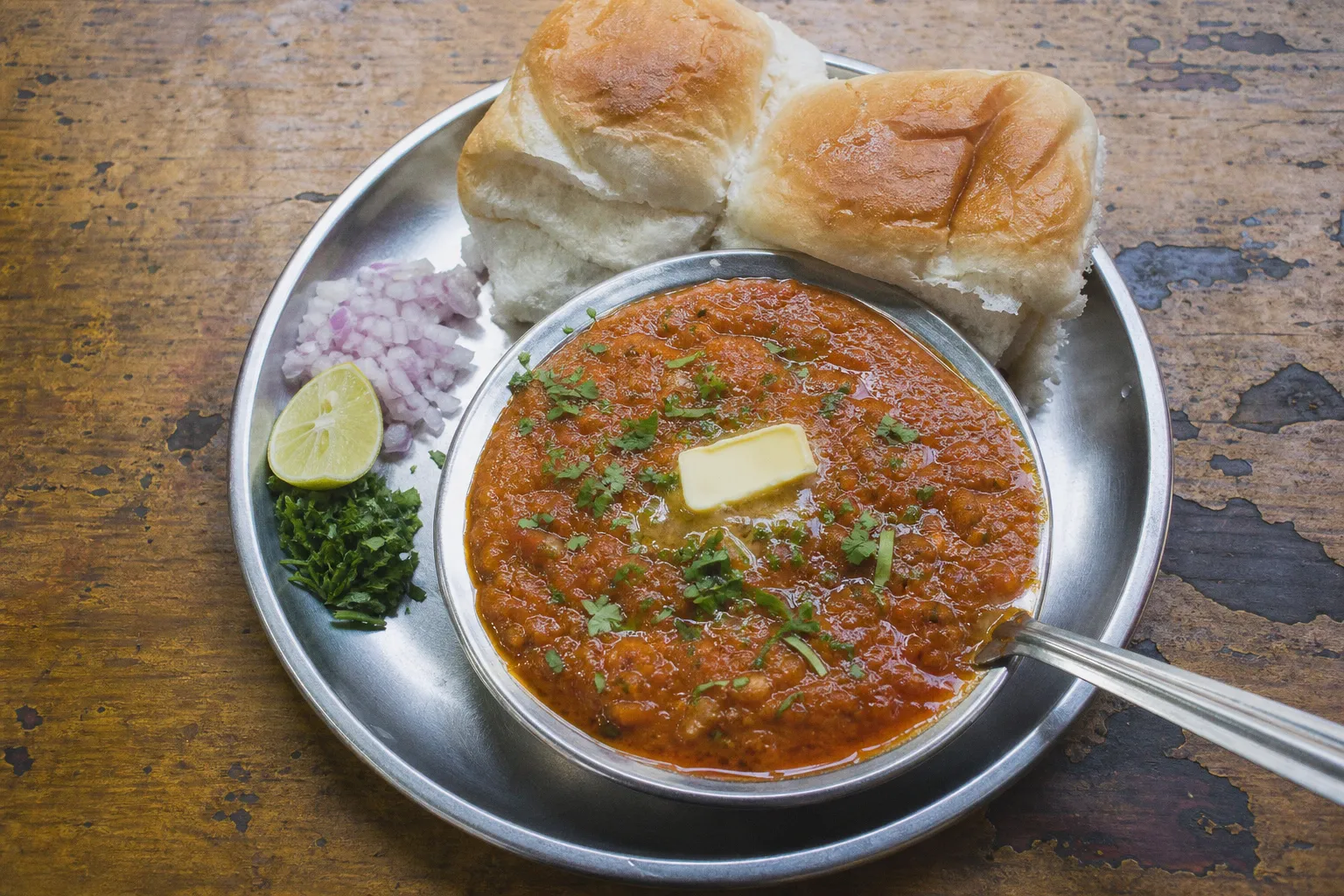
Composition: a thick vegetable curry — base of potatoes, tomatoes, peas, cauliflower, bell peppers — cooked and mashed on a flat iron griddle (tava), finished with a high butter load, served with two to four buttered and toasted buns (pav).
Price band: ₹100–₹250 per plate, with geographic variance of roughly 100% between Ghatkopar (lower) and South Mumbai tourist zones (upper).
Operating parameters: Pav Bhaji batches are held hot on the tava for 60–90 minutes before they develop a surface crust and lose their characteristic smoothness. Request a fresh batch if the surface appears dry. The dish originated in the 1850s as a quick lunch for textile mill workers in what was then Bombay, engineered to deliver high caloric intake in under ten minutes — a function it still performs.
Chaat items: Bhel Puri and Sev Puri
Composition (Bhel Puri): puffed rice, fried sev noodles, chopped onion, tomato, coriander, tamarind chutney, green chutney, and chaat masala. Served cold. Mixed at point of sale.
Composition (Sev Puri): flat crispy puri disc topped with onion, tomato, sev, chutneys, and yogurt variants depending on the vendor.
Operating parameters: Chaat cannot be stored. It is assembled in the customer's presence, typically within 30 seconds of order. This makes it the lowest-risk category in the street food system by hygiene criteria — there is no holding time, no reheating, no batch exposure. It is also the most variable in flavor. Return to vendors that meet the standard.
Bhel Puri has historical association with Girgaon Chowpatty, where it has been sold for over a century. The item is not a single dish but a preparation method applied to multiple base ingredients. Variations include Jhalmuri, Mamra, and dry-bhel variants.
The rule is structural: every batch has a window. The window for fried items is approximately 90 minutes. The window for Pav Bhaji on the tava is the same. Chaat has no window — it is assembled in front of you. Work backward from this.
Historical roots
Mumbai's street food lineage tracks the city's own. The Khau Galli as an operating form emerged from the late-19th-century expansion of textile mills in central Bombay — mill workers needed calorie-dense meals that could be assembled and consumed in under fifteen minutes. Pav Bhaji, Misal Pav, and Vada Pav are direct descendants of this labor-era cuisine: starch-heavy, deeply spiced, portable, cheap. The format survived the deindustrialization of the 1980s because the same logic applied to any high-density workforce — office workers, students, daily commuters.
Mohammad Ali Road's kebab culture took shape later, as post-Partition migration in the late 1940s and 1950s brought kebab traditions from Lucknow, Old Delhi, and the Khyber-pass towns into a Bombay Muslim community rebuilding its commercial life. Seekh Kebab, Baida Roti, and Bheja Fry are not native Maharashtrian foods — they are imports that found their operating model in the Khau Galli format and stayed.
The beach-side stalls at Girgaon Chowpatty carry a third lineage, tied to leisure consumption and evening outings from the early 20th century onward. Bhel Puri's commercial rise tracked the Chowpatty promenade becoming a public gathering space under late colonial rule — beach leisure, evening crowds, and a portable snack that could be assembled in seconds. The vendors there are running a format as old as the promenade itself.
The system that the foreign visitor encounters today is therefore not a static tradition but a working synthesis — mill food plus kebab migration plus beach leisure — that has hardened into the operational structure described above. What looks like chaos is a logistics model with roots in the colonial-era city, refined by a century of foot traffic and refined again by modern rent economics.
Operational timing
Mumbai's street food system runs on two defined surges:
1. Midday surge (12:00 PM – 2:30 PM): driven by office worker density. Vada Pav and Pav Bhaji are at peak quality. Stalls near commercial districts — Churchgate, Fort, Lower Parel — operate at maximum throughput.
2. Evening surge (6:00 PM – 10:30 PM): driven by general foot traffic and post-work consumption. Mohammad Ali Road activates for non-vegetarian items after sunset. The full menu is available. This is the highest-volume and most chaotic period.
Travelers arriving before 11:00 AM will encounter only early-morning items (Vada Pav, Misal Pav, kanda poha, upma) and reduced vendor presence. Travelers arriving after 10:30 PM will encounter depleted inventory, older batches, and closing operations. The recommendation for freshest batches — late afternoon to late evening — applies to most cooked items. For chaat, which has no holding time, freshness is constant throughout the active period.
Safety protocol
Street food in Mumbai is not categorically unsafe, and most vendors maintain high operational standards. However, the foreign traveler's gut is not calibrated for local microbial loads, water content in raw produce, and spice concentrations. The following protocol reflects widely recommended practice for short-term foreign visitors to South Asia and substantially reduces incident probability when applied consistently:
Water and ice
- Consume only sealed bottled water. Standard brands: Bisleri, Kinley, Aquafina. Verify the seal is intact before opening.
- Do not consume ice from street vendors. The water source cannot be verified.
- Request "no ice" in any beverage not sealed at point of purchase.
- Avoid fresh juice vendors who add ice or use non-bottled water for dilution.
Raw items
- Avoid raw salads, raw chutneys held in open containers, and cut fruit displayed in the open.
- Cooked chaat (Bhel Puri, Sev Puri) is acceptable: ingredients are fried or dry at base.
- Onions and tomatoes used as toppings on cooked items are acceptable when the base item is freshly prepared.
Vendor hygiene indicators
- High turnover: a busy stall is statistically safer than a quiet one. Turnover means inventory does not sit.
- Vendor using tongs, gloves, or dedicated utensils: operational indicator.
- Reject: vendor handling cash and food simultaneously without intermediate cleaning; vendor displaying food uncovered near vehicle exhaust; vendor reusing oil (check for dark color and thick consistency).
Personal protocol
- Consult a travel medicine practitioner before departure. Discuss antibiotic options for adult travelers — azithromycin is the most commonly prescribed first-line option for South Asia given regional resistance patterns; ciprofloxacin is also used but less reliably.
- Carry oral rehydration salts (ORS) sachets. Available at any Indian pharmacy without prescription at ₹15–₹25 per sachet.
- If symptoms develop — typically within 6–24 hours of consumption — the standard onset is acute but short-duration. Hydration is the primary intervention. If symptoms persist beyond 48 hours or include blood, seek medical attention.
The term Delhi Belly refers to traveler's diarrhea and applies across India. Mumbai's street vendors are not uniquely risky; the protocol above applies universally to South Asian street food systems.
Hygiene is a probability system, not a binary. A busy Vada Pav vendor at 7:00 PM is a different risk profile from a quiet one at 2:00 PM. Same item, same zone, different batch age, different foot traffic. Read the stall, not the guidebook.
Geographic deployment
For a foreign visitor with limited time in Mumbai (1–3 days), the following deployment covers the core system without redundancy:
Day 1 — Churchgate and Fort
Begin with Vada Pav from a Churchgate-area stall between 12:00 PM and 1:00 PM. Follow with Pav Bhaji from a Fort or Colaba vendor. Finish with Bhel Puri from a designated stall. This sequence calibrates the palate to the system's flavor baseline.
Day 2 — Mohammad Ali Road
Activates after 6:00 PM. Meat-heavy menu. Recommended items: Seekh Kebab, Baida Roti, and if available, Phirni or Malpua for dessert. This is not a vegetarian zone. Visitors with dietary restrictions should verify options in advance.
Day 3 — Ghatkopar and beach-side
Ghatkopar is reached via the Central Line (Ghatkopar station, approximately 25 minutes from CST). Pav Bhaji here is distinct from Churchgate variants — heavier on butter, served with raw onion and lemon, ₹100–₹140 per plate. End the circuit at Girgaon Chowpatty or Juhu for late-evening Bhel Puri with a sea-facing consumption.
Pricing is consistent across neighborhoods for Vada Pav (₹15–₹30). Pav Bhaji varies more — roughly ₹100 in Ghatkopar, up to ₹250 in South Mumbai for tourist-oriented variants. Foreign visitors will not be charged differentially at most stalls; the "tourist price" phenomenon is rare in street food but exists in auto-rickshaws and certain tourist-zone restaurants.
Operational sequence
Before departing for any Khau Galli:
1. Cash secured. ₹500–₹1,000 in small denominations (₹10, ₹20, ₹50, ₹100 notes). Most vendors do not accept card. QR-code UPI is increasingly accepted but unreliable.
2. Bottled water carried or purchased at point of entry. Do not rely on vendor water.
3. Hand sanitizer applied before eating. Most stalls do not provide handwashing facilities.
4. ORS sachet carried in day-pack.
At the stall:
5. Observe batch age. For Vada Pav: vadas should be golden and hot. For Pav Bhaji: surface should be visibly moist.
6. Order items individually; do not request combined platters unless familiar with the vendor.
7. Consume immediately. Do not carry cooked items for more than 20 minutes before eating.
8. Verify chutney containers are covered and dispensed with a dedicated utensil.
After consumption:
9. Monitor for symptoms over the following 12 hours.
10. If symptoms emerge, hydrate with ORS solution. Do not consume dairy, alcohol, or caffeine during symptom periods.
11. Avoid street food for 24 hours following any gastrointestinal event.
Closing position
Mumbai's street food system rewards the prepared traveler and penalizes the casual one. The items are consistent, the geography is fixed, the pricing is transparent, and the timing is predictable. What remains is risk mitigation, which is a function of protocol rather than luck. A foreign visitor who follows the timeline above and adheres to the safety criteria will consume the full range of Mumbai's iconic street items within three days, at a total cost below ₹1,500, with incident probability comparable to or better than tourist consumption patterns in most major Asian cities.
The Khau Galli is not an experience to be had. It is a system to be operated. Operate it correctly.