Indian street food in Delhi: iconic snacks compared
Delhi street food is not one cuisine and not one safe bet. It is a collision of frying pans, chutneys, dairy, wheat, lentils and syrup—sometimes brilliant, sometimes aggressively overrated, often…
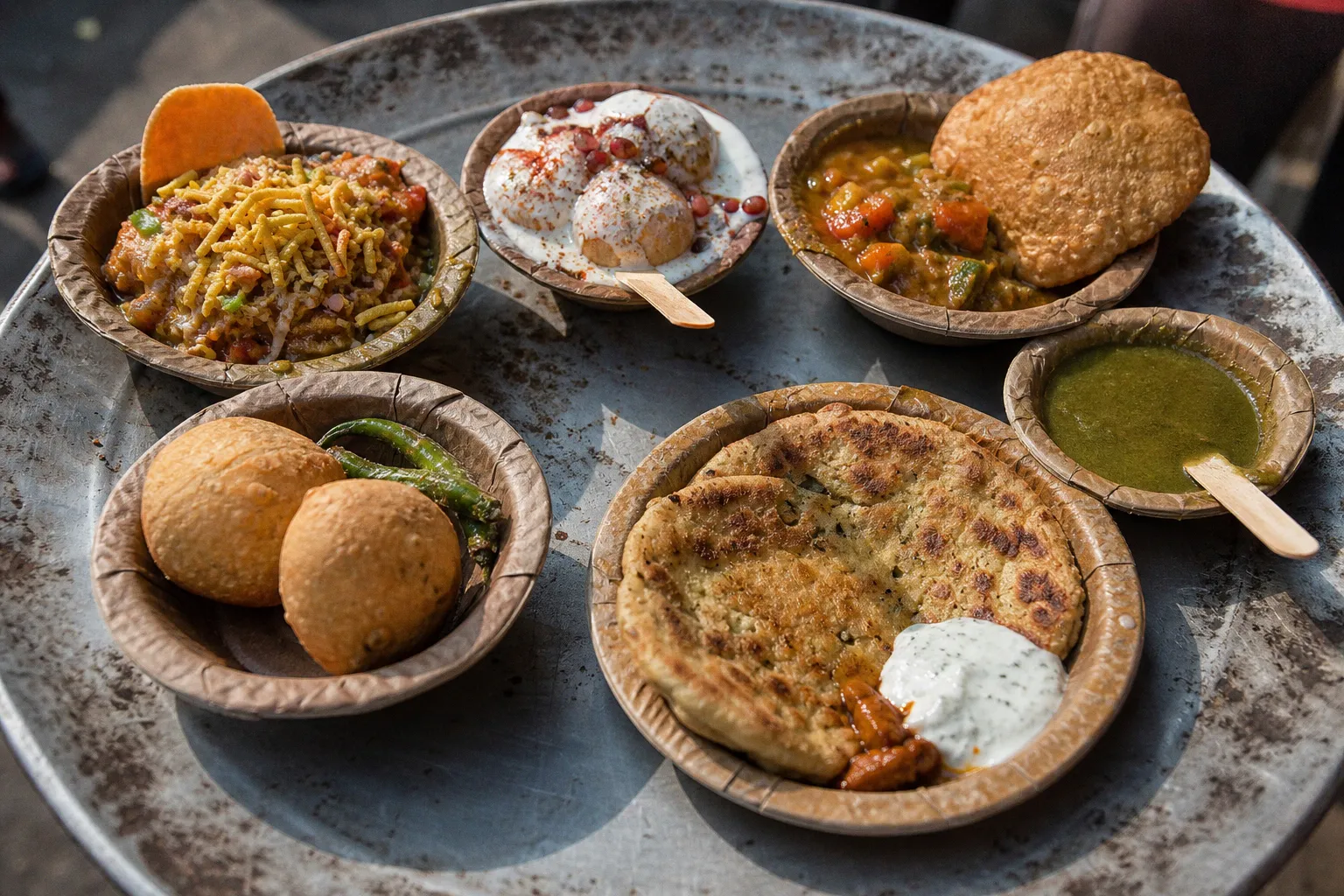
Delhi street food is not one cuisine and not one safe bet. It is a collision of frying pans, chutneys, dairy, wheat, lentils and syrup—sometimes brilliant, sometimes aggressively overrated, often eaten too quickly by visitors who mistake a famous lane for a quality guarantee.
Old Delhi earns its reputation, especially around Chandni Chowk. But the smart move is not to arrive with a “must eat everything” checklist. It is to understand what each snack is actually trying to do: a ghee-heavy meal, a sharp acid hit, a cooling dairy dish, or a sugar bomb. Order accordingly. Your stomach—and your sightseeing schedule—will thank you.
Chandni Chowk is the headline, not the whole story
For Indian street food in Delhi, Chandni Chowk is the high-yield starting point. It concentrates the categories visitors came for: chaat, stuffed paranthas, kachori, gol gappe, dahi bhalla, chole bhature and jalebi. The lane is not subtle. Neither is the crowd management.
This is where the phrase “Old Delhi street food guide” can become misleading. Old Delhi is not a neatly curated food hall with uniform standards. It is a dense working district where historic sweet shops, snack counters, market stalls and full restaurants overlap. You may be standing near a century-old parantha address one minute and a stall selling something entirely different the next.
The useful distinction is between food that is made and served immediately, and food that has been sitting in a tray through heat, dust and repeated handling. The former is usually the stronger play. A busy counter helps, but it is not a hygiene certificate.
Paranthewali Gali remains the obvious stop for paranthas. Its food identity dates to the 1870s, when parantha shops moved into the lane. That history matters, but don’t romanticize it into a blank cheque. This is a place to eat one focused, heavy dish—not to turn lunch into a competitive sport.
In Old Delhi, “iconic” tells you where to look. It does not tell you what to order, how much to eat, or whether the counter is being run well today.
Paranthas versus chaat: meal logic versus snack logic
The Delhi chaat vs. paranthas debate is easy to settle once you stop treating both as generic “street food.” They solve different problems.
A parantha is commitment. In the Paranthewali Gali tradition, it is stuffed, fried in pure ghee in a cast-iron pan, and delivered with mint chutney, banana-tamarind chutney, vegetable pickle and aloo subzi. That is not a light breakfast before a packed day around the Red Fort and Jama Masjid. It is lunch with consequences.
Chaat is more modular. The name covers a family of dishes rather than one fixed recipe: potatoes, fried crisp elements, chickpeas or lentils, yogurt, tamarind, spices and chutneys can all enter the equation. The point is contrast—crunch against softness, sweet against sour, yogurt against chilli. When it works, it is fast, layered and far less monotonous than the average tourist-facing “Indian snack platter.”
| Parameter | Stuffed parantha | Delhi chaat |
|---|---|---|
| Core experience | Rich, fried, filling | Tangy, crisp, messy, fast-moving |
| Best time to eat | When it can replace a meal | Between sights or as a light shared stop |
| Main risk | Over-ordering; ghee fatigue | Water, yogurt and pre-prepared components |
| Texture | Dense, flaky, soft at the centre | Built on contrast: crisp, creamy, soft, sharp |
| Good first choice | Potato, cauliflower or pea filling | Aloo tikki or a freshly assembled papdi-style chaat |
| Bad strategy | Ordering multiple varieties solo | Assuming all chaat is the same dish |
Paranthas come with a surprisingly broad filling range. Potato, cauliflower and peas are the conventional entry points. Lentils, fenugreek, radish, papad, carrot, paneer, dry fruits and even rabdi appear in the wider Old Delhi tradition. That variety is interesting on paper. In practice, some novelty fillings are a tourist trap: more memorable as a menu story than as a balanced meal.
Start with a vegetable filling that lets you judge the dough, the ghee and the accompaniments. If the bread is greasy rather than crisp-edged, if the chutneys taste stale, or if the potato curry has been sitting around too long, do not reward the mythology with a second order.
Chaat has a different problem: visitors often order “chaat” as though it were a single canonical item. It is not. Delhi Tourism describes an original-style mix involving potato, crisp fried bread, dahi bhalla, gram, spices, ginger-tamarind sauce, coriander and yogurt. Aloo tikki is another major branch: a fried potato patty, typically built into a hotter, more substantial plate.
If you want the cleanest read on a counter, aloo tikki is usually a better first move than a sprawling, heavily dressed bowl. You can see whether it is fried to order. You can watch the assembly. And you can ask for the chutneys in a controlled amount rather than drowning the whole thing in sweetness.
The snack categories visitors confuse most
The fastest way to make bad choices in Chandni Chowk is to order by appearance. Several Delhi staples look like variations on “fried thing with sauce.” They are not interchangeable.
Kachori: the compact, filling option
Kachori is a fried, stuffed pastry, often filled with pulses. In Old Delhi, urad-dal kachori served with aloo subzi is a classic format. Think of it as a dense, savoury parcel with a potato curry alongside—not as a crisp nibble to casually add after a parantha.
A good kachori should have an audible crack in the shell and a filling with actual lentil character. A limp one is not “authentic.” It is simply a poor return on your appetite.
Dahi bhalla: cooler, softer, more delicate
Dahi bhalla is built around deep-fried urad-dal dumplings covered in whipped curd, often with sweet-sour tamarind chutney and pomegranate seeds. It is soft, dairy-forward and designed to tame heat rather than amplify it.
This is where the safe street food for foreigners question becomes more serious. Yogurt is not inherently a problem; mishandled dairy is. Pick a counter with rapid turnover and staff assembling portions continuously. If the bhallas are sitting submerged in dairy for a long stretch, the visual may be inviting. The cost-benefit ratio is not.
Gol gappe: maximum excitement, maximum judgment call
Gol gappe are crisp hollow shells filled and flooded with spiced, tangy water. They are among Delhi’s essential chaat items, and they are also the least sensible place for performative bravery.
The standard serving rhythm—one after another, quickly—means you have little control once the vendor begins. For a newcomer, inspect the water setup before ordering. Is the water covered? Are serving vessels clean? Is the vendor handling cash and food with the same hand? Are the shells dry and stored above floor level?
If the answers are weak, skip them. Delhi has no shortage of food. There is no medal for treating a dubious pani vessel as an initiation ritual.
Jalebi: dessert, not a digestive reset
Jalebi is batter piped into a coiled shape, deep-fried, then soaked in syrup. It is crisp at its best, sticky by design, and very sweet. This is not the delicate finale that follows an already heavy meal. It is the meal’s loudest component.
Order a small portion when it is visibly being fried and soaked in fresh batches. The appeal is temperature and texture: hot, crisp coil; syrup inside. Cold, soggy jalebi is one of the clearest examples of Old Delhi food trading on reputation after the product itself has stopped trying.
The best Chandni Chowk food comparison is not “which dish wins?” It is “which dish earns the next 45 minutes of your day?”
Chole bhature: the heavyweight that needs a plan
Chole bhature is spicy chickpeas served with fried bread. It is a Delhi staple for good reason: the chole should be deep, earthy and spicy; the bhatura should arrive inflated, hot and clearly fresh from the fryer.
It is also one of the easiest dishes to misjudge. A fresh bhatura is dramatic but short-lived. Let it sit, and it turns oily, chewy and pointless. Order when you are ready to eat immediately, not when your group is still filming the plate.
The practical comparison looks like this:
1. Choose chole bhature when you need a full meal. It is high-volume, fried and filling. Build your itinerary around it rather than stacking it with paranthas.
2. Choose a parantha when the bread itself is the destination. The stuffing, ghee and chutney combination is the point. It is less about spice, more about richness.
3. Choose chaat when you want variety without a full stop in the day. Share two different preparations. This gives you contrast without forcing one person through an entire heavy plate.
4. Choose kachori for a compact savoury hit. It travels better than chaat and is less operationally risky than water-based snacks when freshly fried.
5. Choose jalebi as a targeted dessert stop. Not because every itinerary says you must, but because a hot batch is genuinely hard to replicate elsewhere.
Visitors often try to conquer all five in a single sweep. That is a poor itinerary, not culinary ambition. Old Delhi rewards pacing. Eat one substantial item, one chaat item, then walk. The area has enough sensory overload without adding a self-inflicted food coma.
The same principle applies near Jama Masjid, where the food scene extends beyond vegetarian snacks into kebabs, tikkas, fried chicken, nihari and other meat dishes. Do not assume “Delhi street food” means vegetarian by default. Equally, do not assume every famous meat counter is a street stall; Old Delhi’s food map includes established restaurants as well as vendors.
A hygiene filter that is actually usable
The usual advice—“eat where locals eat”—is too vague to be useful. Locals have local immunity patterns, local routines and better knowledge of who is reliable on a given day. A queue is a positive signal. It is not a medical protocol.
India’s food-safety framework does provide practical benchmarks. FSSAI guidance for street-food environments states that food containers should be kept at least 15 centimetres above the ground, water and ice used for preparation should be potable, perishable food left at room temperature for more than two hours should be discarded, and disposable serving items should not be reused.
You cannot audit the full system from the pavement. You can use those benchmarks to make faster calls.
Look for these signals:
- Heat and turnover: frying, griddling and assembling in front of you beats pre-plated food every time. Freshly cooked food is the high-yield choice.
- Protected ingredients: chutneys, yogurt, chopped onions and water should not be sitting fully exposed to traffic dust and flies.
- Water discipline: for gol gappe, juices and ice-based drinks, this is the decisive factor. Covered containers and clean serving tools matter more than a famous signboard.
- Elevation and storage: food held above ground level is a basic but revealing standard. Containers on the pavement are an immediate downgrade.
- Single-use service: disposable bowls, spoons and plates should look genuinely new. Reused disposable ware is a hard no.
- Cash handling: a vendor who takes money, touches food, then repeats the cycle without any separation is not automatically making you ill. But it is a rational reason to choose the next stall.
None of this proves a stall is safe. It reduces obvious risk. There is a difference.
If you have just arrived in India, start with hot paranthas, kachori, aloo tikki or hot jalebi. Give raw chutneys, exposed yogurt dishes and water-heavy snacks a little more scrutiny until you understand your own tolerance. This is not fearfulness. It is itinerary protection.
The best order is the one that fits the day
The best street food spots in Delhi are not necessarily the ones with the longest social-media queues. They are the counters that serve a specific dish well, at the moment you arrive, under conditions you can assess.
Chandni Chowk is worth the effort because it gives you a compressed education in Delhi’s snack logic. Ghee-fried paranthas show the city at its richest. Chaat delivers its best acid-crunch-dairy balance. Kachori offers pulse-filled depth. Dahi bhalla cools the whole equation. Gol gappe bring theatre, with a hygiene trade-off. Jalebi finishes without pretending to be restrained.
The definitive recommendation: do not build a Delhi food day around famous names alone. Build it around fresh preparation, dish timing and appetite management. Order fewer things, watch how they are handled, and let one excellent plate beat five compulsory ones.