Indian culture and traditions: essential etiquette rules
You tilt your head to the right when you mean "maybe" and to the left when you mean "perhaps" — but in India, that same gesture can flatten both answers into a single, friendly wobble that leaves first-time visitors guessing.
The Language of Gestures: Decoding the Indian Head Wobble
The head wobble — a side-to-side tilt, often paired with raised eyebrows or a soft smile — is the first piece of body language most visitors encounter, and almost always the first one they misread. It is not, despite what travel forums insist, a coded "yes." Think of it as a temperature reading rather than an answer: it signals that the speaker has heard you, processed your request, and wants to keep the exchange warm. Yes, no, maybe, "I'll think about it," and "I don't want to disappoint you" can all ride on a single wobble.
The head wobble isn't a riddle — it's a kindness. It says "I hear you" in a way that lets everyone leave the conversation comfortable.
You'll see it from rickshaw drivers, hotel receptionists, waiters, and shopkeepers. The wobble softens refusals that would otherwise feel sharp, which matters in a culture that prizes harmony over bluntness. When a vendor wobbles after you ask for a lower price, the negotiation isn't dead — they're telling you to try a smaller number. When a waiter wobbles after you ask if a dish is spicy, take the warning seriously and order the lassi anyway. The trick is to stop translating the gesture as English and start treating it as a mood: relaxed, attentive, and politely noncommittal.
Dining and Social Interaction: The Significance of the Right Hand
Indian dining etiquette is the piece travelers worry about most, and the one that, once understood, becomes the most rewarding part of any meal. The rule is simple: the right hand is for giving and receiving, the left hand is for personal hygiene. You'll see it at the table when your host tears a roti with the right hand and uses the fingertips to scoop curry, never the palm. You'll see it at the market when a vendor places your change directly into your right palm and waits for your fingers to close around it. You'll see it at the temple when prasad, the blessed food offering, is placed only into an open right hand.
The reasoning is rooted in the same hygiene logic that shaped European table manners — water and soap were scarce, and the left hand historically handled water for cleansing. Over centuries, that practical distinction hardened into a moral one. Today, reaching across a table with your left hand, accepting money left-handed, or eating with your left fingers registers as careless at best, disrespectful at worst.
If you're new to eating with your hands, start with bread. Tear a chapati or roti into small pieces with your right fingertips, use the pieces as edible spoons to pinch a bit of curry or dal, and bring the food to your mouth with your thumb and first two fingers. Avoid the whole palm, which makes a mess and looks ungainly. Wash your hands before the meal — almost every Indian household offers a small brass jug and basin for exactly this purpose — and use the provided finger bowl afterward.
| Situation | Right Hand | Left Hand |
|---|---|---|
| Eating | Pinch, scoop, and bring food to your mouth | Keep on your lap or off the plate |
| Passing items | Offer money, gifts, business cards, food | Never used for these exchanges |
| Greeting | Extend for a handshake | Reserved for personal hygiene |
| Receiving | Cup your right palm to receive change or prasad | Don't use it to take items |
Sacred Spaces: Dress Codes and Leather Restrictions at Temples
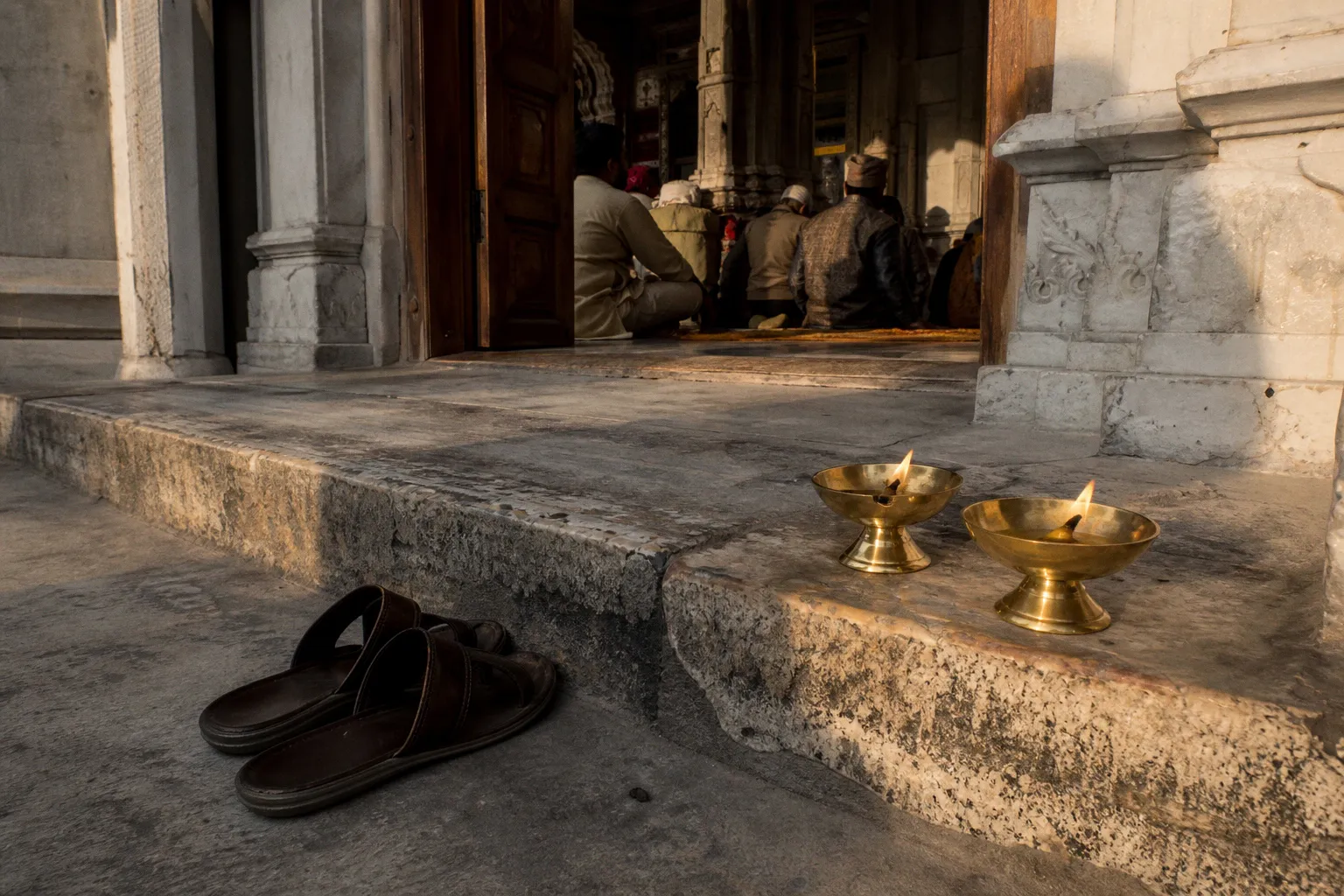
Temples, mosques, gurudwaras, and churches each carry their own protocols, but a few cross-cutting rules apply almost everywhere in India. Footwear comes off at the threshold — not just at grand temples, but at small neighborhood shrines, at the homes you visit, and at certain shops that house a deity. The practice is rooted in the idea that streets carry dust and impurity, while the inner space should be kept clean for the divine. Most religious sites have a shoe-deposit area at the entrance, sometimes with a small fee (₹5–20) and a numbered token. Hand your shoes over without ceremony, pocket the token, and step in.
Modesty matters. Shoulders and knees should be covered for both men and women at most Hindu, Jain, and Sikh sites; mosques require similar coverage plus a headscarf for women. At gurudwaras like the Golden Temple in Amritsar, head covering is mandatory for everyone, and scarves are usually available to borrow at the entrance. Many Hindu and Jain temples go further: they prohibit leather accessories entirely — belts, wallets, bags, watch straps — because the cow is sacred and animal skins carry ritual impurity. If you're carrying a leather bag, plan to leave it with your shoes or in a cloakroom.
Stepping into a temple barefoot isn't a rule imposed on tourists. It's an invitation to leave the outside world at the door.
Inside, behavior follows a familiar rhythm. Walk clockwise around the main shrine, a practice called pradakshina. Don't point your feet at the deity, the altar, or any seated worshipper — feet are considered the lowest, dirtiest part of the body, while the head is the most sacred, which is why you should never pat a child or adult on the head, even affectionately. Sit cross-legged or kneel on the floor if a service is underway. Photography is often restricted to outer courtyards; flash is almost never welcome near the inner sanctum.
Body Language and Personal Space: Navigating Public Conduct
Public space in India reads differently from Western streets. Crowded trains, packed markets, and busy bazaars compress personal space in ways that can feel intrusive until you understand the cultural logic — proximity is normal, not aggressive. That said, several physical boundaries remain firm.
Don't touch anyone's head, including children's, even in play. Don't point your feet at people, altars, photographs of the deceased, or anything sacred. Public displays of affection — kissing, prolonged hugging, sitting on each other's laps — are socially discouraged, especially outside the major cosmopolitan cities and near religious sites. Holding hands between a man and a woman is generally tolerated, but anything more overt will draw stares and, occasionally, polite but firm requests from elders or security staff.
The greeting Namaste or Namaskar solves most introductions cleanly. Palms together at chest level, a slight bow of the head, eye contact, and a soft "Namaste" — that's the whole sequence. It works across genders, ages, and religions, and it sidesteps the handshake ambiguity that often arises in mixed company. In urban business settings, handshakes are common and acceptable, but waiting for the other person to extend a hand first is never a mistake.
Respecting Hierarchy: Understanding Social Distance in Daily Life
India scores 77 on the global Power Distance Index, compared to a global average around 56.5. That single number explains a great deal about why communication here often feels layered. People are accustomed to hierarchical relationships — at work, in families, between customers and shopkeepers — and the default register is respectful rather than casual. Using honorifics ("ji" appended to a first name, "sir" or "madam" for strangers), standing when an elder enters the room, and listening more than you speak are not formality for formality's sake. They are how Indians signal that they take the relationship seriously.
Bargaining follows the same logic. The opening quote at a market is rarely the final one. A 10–20% discount is standard when you bargain politely, smile, and walk away slowly; aggressive haggling or visible irritation flips the mood and usually ends the conversation without a sale. Tipping sits at 5–10% in restaurants, but check the bill — many upscale establishments already add a service charge. For rickshaw and taxi drivers, round up the fare; for hotel staff who go out of their way, a small note tucked into a handshake is genuinely appreciated.
Hierarchy also explains why questions that would sound direct in English often arrive wrapped in softer language. Indians may agree politely in the moment and clarify later in private rather than contradict a guest face-to-face. If something seems too easily accepted — a meeting time, a delivery date, an order at a restaurant — a gentle follow-up the next day keeps everyone honest without anyone losing face.
Regional identity runs deeper than hierarchy. India's 28 states are not administrative lines drawn on a map; they are cultural mosaics with their own languages, cuisines, festivals, and even sporting loyalties. In Kolkata, declaring for Mohun Bagan or East Bengal carries the same tribal weight as choosing a political party — a marker handed down through generations. Down the coast in Goa, that same loyalty flows toward football, a legacy of four centuries of Portuguese rule. Across India, sport functions the same way it does from São Paulo to Seville: a portable shorthand for who you are and where you're from. The global game's evolution — from village pitches to the 2026 FIFA World Cup and its constellation of legendary players — mirrors how every nation pours its own history into the same contest.
Bringing It Together
Indian social etiquette tips aren't a checklist to memorize before boarding the plane. They're a set of conversations already in progress, and the visitor's job is simply to listen before joining. Most etiquette missteps happen not because travelers are careless, but because they assume the rules from home will translate. They don't — and that's the point.
The right hand, the bare feet, the gentle bow, the polite wobble: each gesture has a story behind it, and most of those stories come down to a few shared values — respect for the sacred, softness in disagreement, attention to hierarchy, and warmth toward strangers. Learn those four ideas, and the rest of the cultural map fills in on its own. You will still misstep occasionally. A shopkeeper will wobble when you wanted a clear answer, a temple will ask you to leave your belt at the door, and a waiter will smile when you reach for the fork. None of it is a test you can fail. It's an invitation to slow down, look around, and travel the way India has always preferred to be met: with curiosity, patience, and an open right hand.