Compare Ola and Uber for Delhi Airport Transfers
Delhi Airport is not a curbside cab airport. That is the first reality to price in. At Terminal 3, Uber and Ola pickups are routed to the Multi-Level Car Parking building — the MLCP — on Level 2, not the arrivals gate.
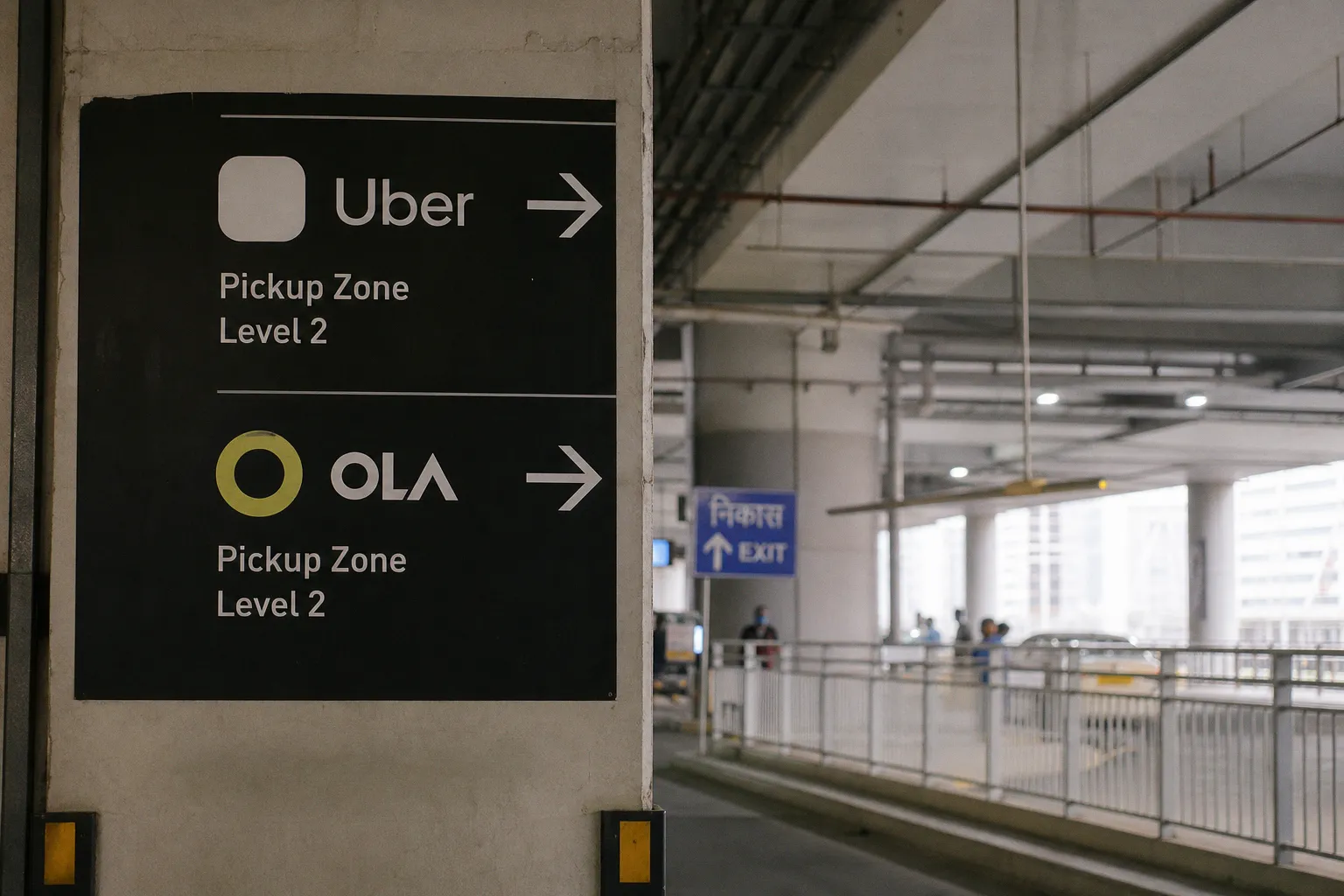
Miss that detail and your “quick airport cab” becomes a sweaty loop of escalators, bad signage interpretation, and driver calls you cannot hear over terminal noise.
The useful question is not simply “Which is cheaper, Ola or Uber?” That answer changes by the minute. The sharper question is how to check, compare Ola and Uber for Delhi Airport transfers without getting trapped by surge pricing, wrong pickup zones, weak vehicle tiers, or the classic Delhi airport mistake: booking before you are physically close enough to the pickup point.
The Logistics of T3: The Pickup Zone Is the Product
At Delhi Airport Terminal 3, both Uber and Ola operate from the designated pickup area inside the Multi-Level Car Parking building, Level 2. The apps may make it feel like the car is coming to you. It is not. You are going to the car.
For related context, see Compare EV Lease vs Buy Options for the $7,500 Credit.
For related context, see Compare Venice Food Tours: Avoid Tourist Traps in Rialto.
That distinction matters more at DEL than at many international airports because T3 has heavy passenger waves, multiple transport channels, and security enforcement that does not tolerate casual curbside pickups. Drivers cannot simply slide up to the arrivals gate and collect you. If a driver suggests “come outside near pillar X” in a vague way, treat it as friction, not a shortcut.
The correct flow is blunt:
1. Clear immigration and baggage claim.
2. Exit customs into arrivals.
3. Ignore anyone offering “app taxi same price” verbally. That is usually where the tourist-trap meter starts running.
4. Follow airport signage for Uber/Ola or app-based cab pickup.
5. Move to the MLCP building.
6. Go to Level 2.
7. Book or confirm only when you are close enough to identify your pickup bay and communicate clearly.
This is where many first-time visitors lose time. They book the ride while still waiting for bags, the driver reaches the holding area, the app clock starts to punish both sides, and then the passenger is still ten minutes away from Level 2. The result: cancellation, rebooking at a worse fare, or a driver calling repeatedly while you are trying to decode airport signage.
At Delhi T3, the smartest cab booking is not the earliest booking. It is the booking made when you are actually near the pickup zone.
The MLCP system is not elegant, but it is predictable. And predictability beats the apparent convenience of negotiating with a random driver after a long-haul flight.
Uber vs. Ola: The Real Comparison Is Reliability, Vehicle Tier, and Friction
Both Uber and Ola are widely used for Delhi Airport transfers. Both run 24/7. Both use dynamic pricing. Both can get you from T3 to Connaught Place in roughly 45–75 minutes depending on traffic, road conditions, and time of day.
The difference is in the operating feel.
Uber tends to be the more internationally familiar interface. For foreign travelers landing in India, that matters. The app flow, payment behavior, driver tracking, cancellation logic, and support structure are generally easier to understand if you already use Uber elsewhere. That does not make it automatically cheaper. It makes it lower-friction.
Ola, by contrast, is more locally embedded. It often gives a broader sense of Indian urban mobility, including local categories in many contexts. For airport transfers, its relevant tiers include Ola Prime Sedan and Ola Prime Plus. Prime Plus is positioned toward higher-rated drivers and newer vehicles. In practice, that can be useful after a long flight when you do not want to gamble on a tired hatchback and a driver who cannot find the pickup lane.
Here is the clean comparison that actually matters at T3:
| Parameter | Uber | Ola |
|---|---|---|
| T3 pickup location | MLCP Level 2 | MLCP Level 2 |
| Curbside pickup at arrivals | Not permitted | Not permitted |
| Useful airport tier | Uber Premier | Ola Prime Sedan / Ola Prime Plus |
| Typical sedan examples | Often cars like Maruti Suzuki Dzire or Toyota Etios | Sedan categories vary by supply; Prime Plus aims for newer vehicles and higher-rated drivers |
| App familiarity for foreign visitors | Stronger if you already use Uber globally | More India-specific; can feel less intuitive to newcomers |
| Pricing model | Dynamic pricing | Dynamic pricing |
| Best use case | Lower-friction booking, familiar interface, predictable app behavior | Worth checking against Uber, especially if Prime Plus is available at a rational premium |
| Main risk | Surge pricing during arrival clusters | Surge pricing plus occasional category/vehicle mismatch expectations |
The overrated move is treating one app as the winner before you land. Delhi does not reward brand loyalty. It rewards live comparison.
Open both apps. Set the same destination. Compare the fare, vehicle category, estimated pickup time, and cancellation conditions. Then decide. Do not compare Uber Premier against an Ola mini-class product and pretend you have learned anything. Match sedan against sedan, premium-ish against premium-ish, and time against time.
That is the only honest method.
Decoding Vehicle Tiers: Do Not Buy the Cheapest Ride Blindly
Delhi Airport is one of the few places where I do not recommend blindly choosing the cheapest app cab category. The transfer is not just a ride. It is your first operational test in India: luggage, sleep debt, SIM card uncertainty, traffic, and the need to reach your hotel without a miniature crisis.
Uber Premier is the standard Uber airport-transfer tier worth considering in Delhi. It typically means a sedan class, often cars such as the Maruti Suzuki Dzire or Toyota Etios. These are not boutique-standard vehicles, and nobody should pretend otherwise. They are practical airport sedans: enough boot space for normal luggage, air-conditioning that usually does the job, and a cabin that is acceptable for 45–75 minutes into central Delhi.
Ola Prime Sedan sits in roughly comparable territory. Ola Prime Plus is the more interesting option if the fare difference is modest. Its pitch is higher-rated drivers and newer vehicles. That does not guarantee a polished chauffeur experience. It does improve the probability of a smoother pickup and a less tired car.
The cost-benefit logic is simple:
- If you are solo with one carry-on and arriving during a low-demand window, the cheapest acceptable sedan may be fine.
- If you are two people with checked luggage, do not get clever with tiny categories. Boot space becomes the hidden cost.
- If you land after a long international sector, pay attention to driver rating and vehicle class. Saving a small amount can be a low-yield decision.
- If your hotel is in Old Delhi, Paharganj, or a lane-heavy neighborhood, choose the driver/category combination that looks most reliable, not merely cheapest.
- If you are arriving at peak traffic time, comfort matters more because the “short ride” can stretch.
The trap is assuming that a cab category name means the same thing as it would in London, Singapore, or Dubai. It does not. In Delhi, “sedan” is often compact by global standards. Functional, yes. Spacious, not always.
Dynamic Pricing: The Fare You See Is a Weather Report, Not a Promise
Both Uber and Ola use dynamic pricing based on demand, time of day, and traffic conditions. At Delhi Airport, that means fares move sharply when multiple international flights unload at the same time or when Delhi traffic is already under stress.
Do not ask, “Is Ola cheaper than Uber?” Ask, “Which app is better right now for this exact route, in this exact category, with this exact pickup delay?”
That is how to check compare Ola and Uber for Delhi Airport transfers in a way that produces a useful decision rather than a forum argument.
A disciplined price check takes under two minutes:
1. Enter the same destination in both apps. Use the hotel name only if it maps correctly; otherwise use the full street address or nearby landmark.
2. Compare equivalent tiers. Uber Premier against Ola Prime Sedan or Prime Plus is more meaningful than mixing budget and premium categories.
3. Look at pickup time, not just fare. A cheaper cab that is 18 minutes away may be worse than a slightly higher fare with a driver already in the airport queue.
4. Watch for surge spikes. If both apps look inflated and you are not in a hurry, wait five to ten minutes near the pickup zone and refresh.
5. Check payment method. International cards can be temperamental in India across apps and merchants. Have a backup plan, including cash for emergencies, even if you prefer app payment.
6. Confirm the car plate before moving. Delhi airport cab zones can feel crowded; do not rely on color and model alone.
There is no fixed “right” fare I would print here because that would be false precision. Real-time prices fluctuate by route, demand, and traffic. A number that looks authoritative today can be nonsense tomorrow morning.
For broader context on how Indian cities absorb transport, culture, daily logistics, and local disruption, I sometimes cross-check general urban updates through practical India-focused coverage, but your airport cab decision still has to be made inside the apps, in real time.
In Delhi, the cheapest airport cab is often cheap for exactly three minutes. Then the demand wave hits, and the math resets.
Arrival Clusters: The Hidden Enemy at DEL
The worst time to make a slow decision is when a wave of passengers has just hit the app-cab system. Delhi T3 handles major international and domestic flows, and the pickup area can go from manageable to messy quickly.
Arrival clusters create four problems:
- App fares rise because demand jumps.
- Drivers become harder to identify because many similar sedans enter the pickup system.
- Wait times become unstable.
- Driver calls increase, often while passengers are still navigating the MLCP.
This is where Uber’s interface familiarity can help foreign travelers. If you already know how Uber handles pickup pins, driver messaging, and cancellations, you are less likely to panic-book. Ola can still price better or offer a better vehicle at that moment, but the learning curve is real if you are using it for the first time after a red-eye flight.
My tactical advice: install and set up both apps before you fly to India. Do not wait until you are standing in airport Wi-Fi range with a low battery and a hotel check-in deadline. Add payment methods early. Check whether the app opens cleanly on your phone. Make sure your destination is saved.
This is not tech paranoia. It is basic Delhi airport hygiene.
If you do not have a working Indian SIM yet, airport Wi-Fi may get you through booking, but driver coordination can still be awkward. Some drivers will call rather than text. If your number does not work properly in India, use in-app messaging and keep messages short: “At T3 MLCP Level 2 pickup zone. I am near bay/sign ___.” Avoid essays. Drivers are moving through a controlled pickup environment, not reading a travel diary.
Security Protocols: The Curb Is Not Your Backup Plan
A common bad assumption: if the MLCP pickup feels inconvenient, you can just ask the driver to meet you at the arrivals curb.
No. That is not the system.
At T3, app-based cab pickups are directed to the MLCP Level 2 area. Airport security does not allow Uber and Ola drivers to casually collect passengers at the arrival gate. This rule is not a minor suggestion. It is part of how the airport manages traffic and congestion.
Trying to force a curb pickup usually creates one of three outcomes:
1. The driver refuses or cancels.
2. You waste time walking to the wrong place.
3. You end up vulnerable to touts and unofficial taxi offers.
The third outcome is the expensive one. After a long flight, with luggage and poor local context, the phrase “same price as Uber” should set off alarms. If it is truly the same price, the driver would not need to intercept you at arrivals.
Use the app. Use the designated zone. Take the small inconvenience up front to avoid the larger one later.
Destination Matters: Connaught Place Is Not the Same as Aerocity
Not all Delhi Airport transfers deserve the same cab strategy.
Aerocity is close, hotel-heavy, and usually a short transfer. For Aerocity, fare differences between comparable tiers may be less meaningful than pickup time. If Uber Premier is nearby and Ola Prime Plus is delayed, take the faster rational option. You are not crossing the city.
Connaught Place is a more serious transfer. Expect roughly 45–75 minutes depending on traffic. Here, vehicle comfort and driver reliability matter more. A slightly better sedan tier can be worth it, especially after an international arrival.
Old Delhi, Paharganj, Karol Bagh, and lane-heavy neighborhoods add another layer. The main road journey is only part of the transfer. The final approach can involve congestion, narrow access, unclear hotel frontage, and driver impatience. For these areas, I would bias toward the app/category that shows the better driver profile and clearer pickup coordination, not the lowest fare.
Gurugram is a different calculation again. Depending on your sector and traffic, the transfer can be smooth or maddening. If going to Cyber City, Golf Course Road, or a business hotel cluster, compare both apps carefully and consider whether your hotel has a paid transfer that is overpriced but operationally cleaner. Hotel cars are often poor value; they can still be high-yield when arrival time is brutal and reimbursement is not your problem.
The Best Booking Sequence After Landing
The efficient version is not complicated, but it does require discipline. Here is the sequence I recommend for most international travelers using Uber or Ola from Delhi T3:
1. Do not book at the baggage belt. You are too far from the pickup zone and too exposed to delays.
2. Reach the MLCP first. Follow the airport’s Uber/Ola signage and get yourself to Level 2.
3. Open both apps side by side. Same destination, comparable category.
4. Compare fare plus pickup time. A low fare with a long pickup is not automatically better.
5. Choose a sedan-class product unless you have a clear reason not to. For airport luggage, this is the sane baseline.
6. Message the driver with your precise location. Use bay numbers or visible signs where available.
7. Verify plate and driver before entering. Basic, but not optional.
8. Keep the route open on your own map. Not because most drivers are dishonest; because wrong turns and destination confusion are common enough to cost time.
This is the difference between being a passive passenger and controlling the transfer.
The high-yield move is not finding a magical app. It is sequencing the process correctly.
So, Which Should You Use?
My verdict: use both apps, but default mentally to Uber if you value interface reliability and are new to India; give Ola a real chance if Prime Sedan or Prime Plus is pricing well and pickup time is competitive.
Uber is the safer first-click option for many foreign travelers because the app experience feels familiar and the airport tier is straightforward. Ola is not a second-rate fallback. It can be the better buy in the moment, especially when its sedan tiers line up well against Uber Premier. But it asks for slightly more tolerance of local app behavior and category ambiguity.
Do not be loyal. Be comparative.
For Delhi Airport transfers, the best choice is the app that gives you the better combination of pickup time, sedan quality, driver confidence, and live fare after you have reached the MLCP Level 2 zone. Anything else is guesswork dressed up as advice.
Final recommendation: install both, set both up before arrival, walk to the correct pickup zone, compare equivalent tiers in real time, and book the option with the lowest total friction — not just the lowest number on the screen.