Indian railways booking online for foreign tourists
Your India itinerary looks beautiful on paper: three weeks, Varanasi to Kolkata, with a stop in Bodh Gaya and a slow ride through the ghats. Then you open irctc.co.in to book the train, and the registration form asks for an Indian mobile number.
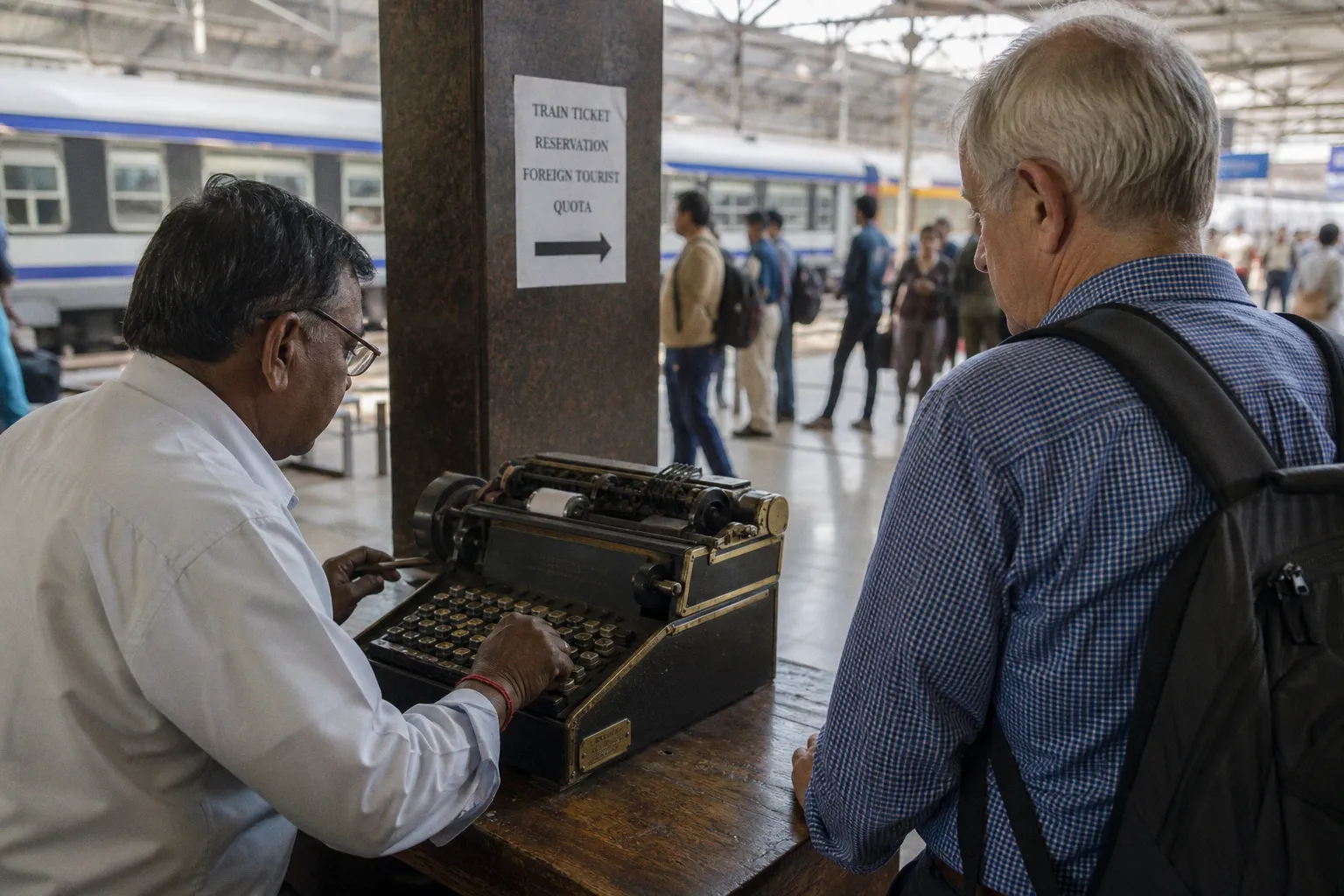
Indian Railways Booking Online: a Guide for Foreigners
Setting Up Your IRCTC Account from Abroad
IRCTC (Indian Railway Catering and Tourism Corporation) is the only official channel for online Indian train booking, and every foreign traveler needs an account there before anything else happens. Registration requires three things: an email address, your full name exactly as it appears on your passport, and a mobile number capable of receiving SMS — either an Indian SIM or an international one.
If you already have an Indian SIM, use it. The OTP arrives in seconds and you move on. If you're on a foreign number, the process becomes slower and slightly less predictable. Indian Railways routes international SMS through global gateways, and delivery can take anywhere from two minutes to several hours depending on your home carrier. Some travelers never receive the OTP on the first attempt and need to request a resend the next morning. A small frustration that compounds fast if you're trying to book a train that departs in two days.
There is also a registration fee — roughly 100 INR plus GST, charged once. Yes, you pay to create the account that lets you pay for tickets. It is what it is. The charge happens in Indian rupees, so the card you use must be comfortable with foreign currency transactions. Most Visa and Mastercard debit and credit cards work; prepaid forex cards sometimes get declined at this stage, so have a backup ready.
Think of IRCTC registration less like signing up for an app and more like applying for a library card at a new city's main branch — bureaucratic at first, but it opens every door after.
The Foreign Tourist Quota — Your Secret Weapon
Most foreign travelers only discover the Foreign Tourist Quota (FTQ) after watching general-class tickets sell out in front of them. The FTQ is a separate reservation pool set aside by Indian Railways for foreign nationals and NRIs, and it frequently has open berths even when the general quota is fully waitlisted. For a traveler building an itinerary around popular routes — Delhi to Agra, Mumbai to Goa, Chennai to Pondicherry — this is often the difference between a guaranteed seat and a stranded afternoon at the station.
FTQ inventory sits in AC classes: 1AC, 2AC, Executive Chair Car (EC), and Chair Car (CC). Sleeper class is not included, which is a real limitation for budget travelers. But for first-time visitors who want comfort, certainty, and the calm of knowing their berth is locked in, the FTQ is worth far more than the small effort it takes to access.
How to actually reach it: the Foreign Tourist Quota is fully integrated into the IRCTC booking flow — once your account is set up and you're logged in, you select "Foreign Tourist" from the quota dropdown when searching trains, and the available berths under that pool appear in the same results screen as everything else. It's not hidden, but it is easy to miss. The default quota is "General," the screen is busy with class options and fare breakdowns, and a foreign traveler who doesn't know to scroll through the quota menu will happily watch a train show as "REGRET/waitlist" without ever realizing a parallel block of seats is sitting right next to it on the same page. A train that's sold out under General can show four or five confirmed berths under Foreign Tourist, visible in the same search, on the same click.
That said, the IRCTC interface is not always cooperative. Payment failures, OTP delays, and the occasional form-error loop send travelers looking for a human alternative, and that's where the offline channels come in. Reservation counters at major railway stations — New Delhi, Mumbai CST, Chennai Central, Howrah (Kolkata), and Bengaluru City Junction among them — have dedicated FTQ desks where the clerk can pull from the same pool you're trying to reach online. Authorized Indian travel agencies that specialize in foreign tourists can do the same, usually for a service fee in the 100–300 INR range, which is a fair exchange for someone handling the form fields, the OTP resends, and the gateway retries on your behalf. So the practical answer is: try IRCTC directly first, because the FTQ lives there and is fully bookable through the official site. If the digital path stalls, the station counter and authorized agents are real backups, not the only path.
The Foreign Tourist Quota is the single most underused tool by foreign travelers in India. If you only learn one thing about Indian train booking, learn this.
Payment Gateways, International Cards, and Transaction Fees
Indian Railways accepts international Visa and Mastercard through several payment gateways — Atom, BillDesk, and Razorpay are the usual suspects. Your card is charged in Indian rupees, and your home bank layers its own foreign transaction fee on top, typically 1–3%. This is universal; there is no way around it. Build it into your budget.
What does catch people off guard is the gateway service charge. Depending on which processor IRCTC routes you to, you may see an additional 30–50 INR tacked on per ticket. It's a small amount on a single booking, but on a multi-leg itinerary across half a dozen trains, it adds up. Worth keeping in mind.
A few practical things worth knowing before you start:
- Prepaid forex cards work in roughly half of attempts. Some Indian gateways reject them outright. Carry at least one Visa or Mastercard debit card as backup.
- 3D Secure codes are usually sent to your home phone number or banking app. Make sure your bank's international transaction alerts and verification methods are active before you begin booking — fumbling with this mid-checkout is stressful.
- Declined transactions sometimes hold a pending charge on your card. Don't panic, and don't immediately retry. Wait 10–15 minutes, then try again. The pending charge almost always drops within 24 hours.
- Currency-conversion markup is where banks make their real money on foreign transactions. The advertised "0% foreign transaction fee" cards still often slip a 2–3% wholesale-rate spread into the conversion itself. Check the small print before you leave home; the difference between a fair-conversion card and a stingy one is noticeable across a multi-train trip.
For travelers who'd rather skip the gateway wrestling entirely, booking through a reputable Indian travel agency that handles IRCTC transactions on your behalf is a legitimate route. The service fee is usually 100–300 INR per ticket, and you trade a small cost for the absence of payment-flow headaches.
Advance Reservation Periods and High-Demand Trains
Indian Railways opens reservations 120 days before departure. That Advance Reservation Period (ARP) is longer than most European rail systems, and for popular routes, those 120 days genuinely matter. A Vande Bharat Express seat on a Friday afternoon Delhi–Agra train can vanish within hours of the booking window opening, not within days.
Here's how demand actually behaves across the main train categories:
| Train type | Booking urgency | Realistic strategy |
|---|---|---|
| Vande Bharat Express | Book within 48 hours of window opening | Set a calendar reminder for 120 days out |
| Rajdhani Express | Book within 1 week of window opening | Have a backup train number ready |
| Shatabdi Express | Book within 2 weeks of window opening | More flexibility, but weekend seats still go fast |
| Regular Mail/Express | Book 2–4 weeks out | Generally available, especially in sleeper class |
| Tatkal (last-minute) | Opens 24 hours before departure | Possible but expensive, and inventory disappears in minutes |
The 120-day window is generous, but it means popular trains effectively require planning three to four months ahead. If your India itinerary is still flexible when you start booking, you'll see far better options than someone trying to lock down a Delhi–Jaipur train two days before departure.
Vande Bharat deserves its own paragraph. These are Indian Railways' semi-high-speed, fully air-conditioned chair car services — no sleeper berths, just spacious reclining seats, modern interiors, and often faster end-to-end times than older express trains. They are also the hardest tickets in the system to acquire. Foreign tourists routinely hear about Vande Bharat, decide they want to ride one, and discover the next available seat is three weeks away. If riding one matters to you, treat it as a fixed anchor date and arrange the rest of your itinerary around it. The Maharaja's experience is on the train itself; the booking is the gate.
Two more wrinkles worth flagging while you're planning around the 120-day window. First, the ARP clock pauses briefly at certain festival periods (Diwali week, major pilgrimages like Kumbh Mela) when Indian Railways occasionally restricts outbound bookings to manage holiday crush — your 120 days out is fine, but the slots immediately around a major festival vanish differently. Second, the Foreign Tourist Quota pool opens at the same 120-day mark as general booking, not earlier; this is a common misconception, especially among travelers who assume "tourist quota" implies some kind of priority window. It doesn't. The advantage isn't timing — it's that the FTQ pool is much less crowded.
Documents, Identity Checks, and the Boarding Moment
When your booking is confirmed, you'll receive an e-ticket via email as a PDF. Print it. Yes, actually print it — or at minimum save it offline on your phone in a way that doesn't depend on roaming data. Indian Railways has moved toward digital verification, but the Traveling Ticket Examiner (TTE) on board routinely asks for the printed slip alongside your ID.
The ID requirement is non-negotiable: the name on your booking must match the name on your passport, character for character. The TTE will check. If you booked under "William James Smith" and your passport says "Bill Smith," you've got a problem that a friendly conversation may or may not resolve. Book under the exact name as printed in your passport — middle names, hyphens, and all.
Other documents worth carrying on board:
- Passport — original, not a photocopy. Digital scans are not accepted as identity verification.
- Visa or e-Visa printout — fine in printed form.
- Booking confirmation email — printed or saved offline as a screenshot.
- Hotel address at your destination — occasionally requested at ticket checkpoints.
- Photocopy of passport ID page — stowed separately from the original, useful if the original is briefly misplaced in luggage.
Indian train platforms have a few quirks worth knowing before you board. Most major stations now run platform-display boards in English showing train number, name, and platform number. There is also a coach-position diagram painted directly onto the platform — find your coach number on your ticket, walk to that painted mark, and board when the train arrives. Trains stop for only a few minutes at smaller stations; at major junctions they sit longer, but don't count on it. The doors don't always wait for the slow.
The boarding moment is when all the digital setup pays off. Walk up with your printed ticket and passport, find your coach on the painted platform diagram, step on. No drama.
Field-Tested Habits That Make Everything Easier
A handful of practices that seasoned India travelers swear by — not rules, just habits that consistently make the booking experience smoother:
1. Book in INR-friendly batches. Don't book one ticket at a time across multiple days; your bank will flag each as a separate suspicious transaction. Group your bookings together, and you'll save yourself the locked-card phone calls.
2. Keep screenshots of every booking confirmation. Email servers occasionally bounce IRCTC messages, and a screenshot has rescued more than one traveler at a ticket check.
3. Use the IRCTC mobile app for tracking, but the website for booking. The app occasionally has payment-flow bugs that the desktop site does not.
4. Arrive at the station 30–45 minutes early on your first long-distance train. Not because the train leaves early — it won't — but because finding your platform, your coach, and your berth in a busy Indian railway station takes longer than you expect. By your third train, you'll be sprinting in five minutes before departure like everyone else.
5. Download the IRCTC Rail Connect app before you leave home. It caches tickets offline and survives the spotty Wi-Fi you'll encounter at smaller stations.
6. Photograph your e-ticket's QR code separately from the PDF. If your phone dies at the worst possible moment, a quick screenshot of just the QR — stored in your camera roll — has pulled more than one traveler through a manual check at the coach door.
A small cultural note worth ending on. Indian Railways has been the connective tissue of this country for over 170 years. The system is vast, the bureaucracy is real, and yes — parts of the booking website feel like they were designed in a different era, because they were. But it works. Millions of Indians book through it every single day, and once you've done it twice, the process becomes muscle memory. The small frustrations at the front end buy you something genuinely rare in modern travel: a journey worth slowing down for.
Watching the subcontinent unroll from a train window — the changing light across states, the snack vendors appearing at every stop, the chai wallah calling out his price in a voice you learn to recognize by your third day — is the India travelers remember most. Getting the booking right is the price of admission to that experience, and it's a small one once you know where to click.