India Tourist Visa for UK Citizens: e-Visa vs Paper
For most British travellers, the India tourist visa decision is not complicated: the e-Tourist Visa is the high-yield option, and the paper route is slower, more expensive in effort, and usually unnecessary.
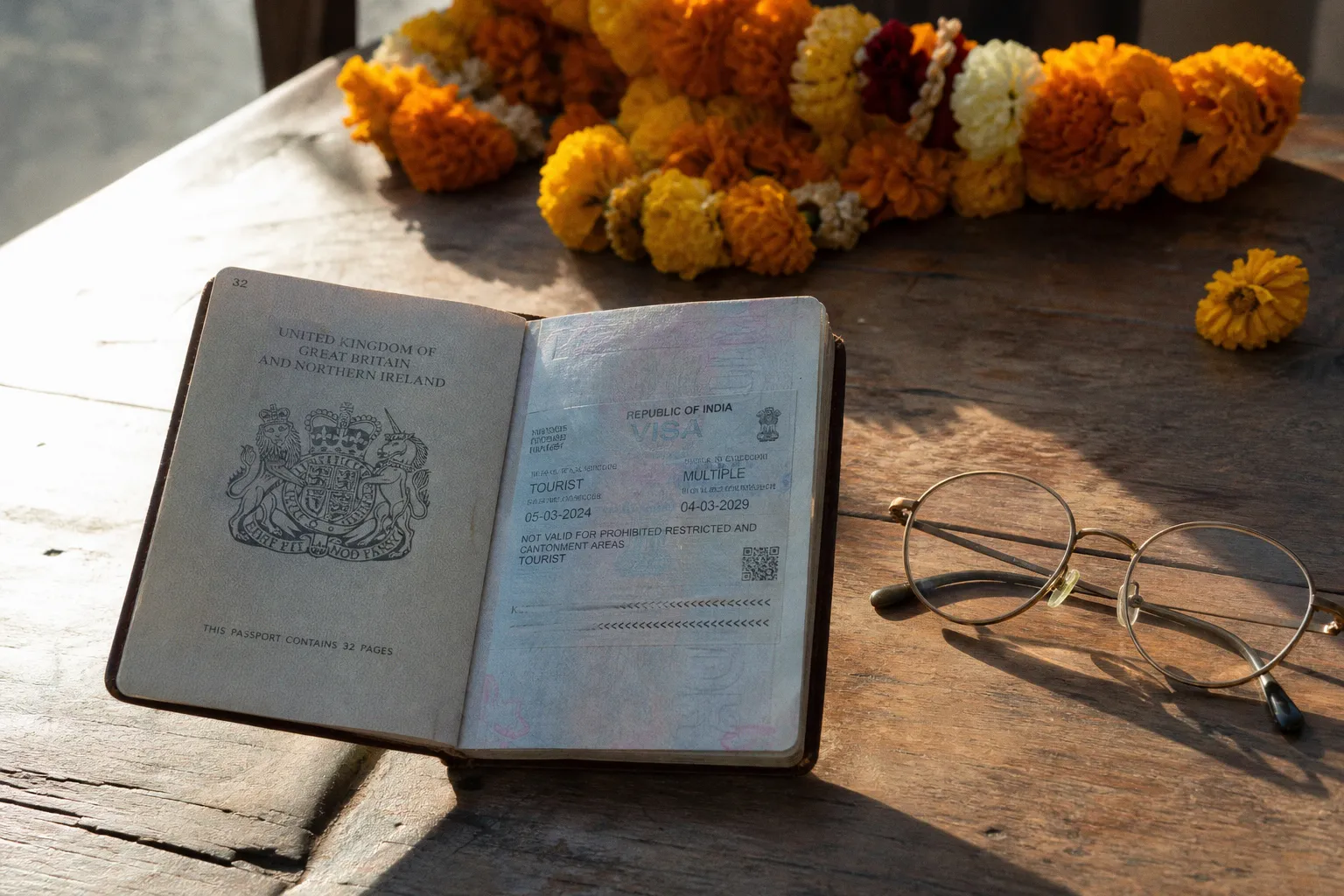
But "usually" is doing real work here. India's e-visa is not a universal digital pass. It has purpose limits, entry-point restrictions and a hard ceiling on how long you can remain in the country. Get outside that lane—an extended stay, the wrong passport status, a route into protected territory—and the supposedly outdated paper visa can become the only sensible route.
The first correction: there is no casual "visa on arrival" for a UK holidaymaker. British citizens need a visa before travelling unless they hold a valid OCI card. An e-visa still requires an approved Electronic Travel Authorisation before boarding the flight. Immigration takes your biometrics on arrival; it does not decide whether to grant you a tourist visa at the desk.
The e-Tourist Visa: the default choice, with a narrow operating brief
For a standard UK passport holder flying in for a holiday, the e-Tourist Visa is the clear winner. The application is online. You upload a recent front-facing photograph and a scan of the passport's biographical page, pay online, wait for the ETA, then travel with a printed copy showing the status "GRANTED."
That is the attractive part. No VFS appointment. No printing a form to sign. No commute for fingerprints before the trip. No administrative theatre masquerading as security.
The less attractive part is that an e-visa is a tightly specified product. It works brilliantly when your trip matches the product. It becomes a tourist trap when travellers assume "digital" means "flexible."
UK citizens can apply for three e-Tourist Visa durations:
| Visa option | Entry pattern | Stay rule | Best use |
|---|---|---|---|
| 30-day e-Tourist Visa | Multiple entry | Non-extendable, non-convertible | A normal holiday, short multi-stop itinerary, quick return visit |
| One-year e-Tourist Visa | Multiple entry | Total stays capped at 180 days in a calendar year | Frequent travellers, longer but compliant visits |
| Five-year e-Tourist Visa | Multiple entry | Total stays capped at 180 days in a calendar year | Regular India visitors who value convenience over price |
The headline is simple: the one-year and five-year visas are not permission to live in India for a year or five years. Their validity period is long; the allowable time physically spent in India is not. The total stay is capped at 180 days in a calendar year.
That distinction catches out people booking a long winter in Goa, an extended "work remotely from India" experiment, or a loose six-month rail itinerary. A long-validity visa is not the same thing as long residence rights. India is not subtle on this point, and trying to negotiate the interpretation at immigration is a terrible value proposition.
The e-visa is excellent for a holiday. It is overrated when your plan depends on exceptions, extensions or improvisation.
There are other boundaries. An e-visa is not valid for Protected, Restricted or Cantonment Areas without prior permission. Do not treat the visa approval as a blanket access pass for every part of the country. If your itinerary includes border regions, sensitive Himalayan areas, island areas or places subject to special permits, confirm the separate permission requirements before you book non-refundable transport.
The e-visa also does not fit every traveller. It is unavailable to holders of diplomatic or official passports, people travelling on documents other than a standard individual passport, and travellers included in a parent's or spouse's passport. Pakistani passport holders and people of Pakistani origin face separate rules; this is not a category to solve with a generic online form and optimism.
For the typical British tourist with a full UK passport, however, none of that is a reason to overcomplicate a Delhi–Agra–Jaipur circuit or a Kerala holiday. Use the e-visa. Spend your attention on the itinerary instead.
The paper visa: friction first, but not pointless
The paper visa route in the UK begins online, which causes understandable confusion. Filling out the Indian government form does not complete the application. You must print and sign it, assemble the supporting documents, book an appointment at a VFS Global application centre and attend in person for fingerprints and a photograph.
That is a lot of process for a tourist visa. It is also why the paper route should not be selected merely because it feels more "official." Both routes are official. One is simply less efficient for mainstream tourism.
The paper application makes sense when the e-visa does not fit your passport, status, intended purpose or travel pattern. It may also be the route to investigate where a traveller needs a different visa category rather than a tourist visa at all. That distinction matters. A tourist visa is not a workaround for paid work, formal study or unrestricted volunteering. Calling your trip "tourism" on a form does not change what you will actually do in India.
Here is the practical comparison for an Indian visa for UK citizens:
| Decision point | e-Tourist Visa | Paper visa through VFS |
|---|---|---|
| Application method | Fully online | Online form followed by physical submission |
| UK appointment | Not required | Required |
| Pre-travel biometrics | Taken on arrival in India | Taken at the VFS appointment |
| Best fit | Straightforward tourism on an eligible standard passport | Cases outside e-visa eligibility or where another visa category is needed |
| Extensions/conversion | Non-extendable and non-convertible | Do not assume flexibility; conditions depend on the visa category and immigration rules |
| Time cost | Low administrative burden | Higher: form, paperwork, travel to VFS, appointment attendance |
| Entry points | Only authorised immigration check posts | Do not assume unrestricted entry; verify conditions for the visa and route |
The key point is not that paper is "better" or "worse." It is a different tool with a much higher transaction cost. If you live far from an application centre, the hidden cost is not just a service fee. It is a day off work, rail fares, parking, the risk of a rejected photograph, and the familiar VFS experience of discovering that a document needs to be printed in exactly the format you did not bring.
Paper is the right answer when it is genuinely required. It is not a premium upgrade.
Cost: the five-year e-visa is a bad bargain for most people
The India tourist visa UK fee structure is more revealing than it first appears. The e-visa costs published for UK nationals are in US dollars, with a 3% bank charge added. The official table dated 9 July 2026 lists:
- US$10 for a 30-day e-Tourist Visa for arrivals from April through June.
- US$25 for a 30-day e-Tourist Visa for arrivals from July through March.
- US$40 for a one-year e-Tourist Visa.
- US$484 for a five-year e-Tourist Visa.
The seasonal 30-day pricing is worth noticing. It is not a typo. A traveller arriving in May pays materially less than someone arriving in October for the same 30-day product. The arrival period, not merely the date you fill in the form, is part of the calculation.
The one-year visa is the standout. At US$40 plus the bank charge, it costs only modestly more than the standard US$25 30-day option for most of the year. If there is a realistic chance you will return to India within 12 months—a second visit to Rajasthan, a wedding, a stopover added to a Southeast Asia itinerary—it is often the more rational purchase.
The five-year option is different. At US$484 before the extra bank charge, it is expensive enough that it needs actual arithmetic, not the emotional comfort of "I'll have it sorted for years." Unless you expect repeated India trips over several years and value avoiding future applications more than the substantial upfront outlay, it is hard to call high-yield.
The paper visa is harder to compare cleanly. Its total can include the visa fee, consular surcharge and VFS service charges, which may be listed separately and can change. Add the cost of attending an appointment, and a paper application rarely wins on price for a straightforward tourist. It wins only when it solves an eligibility or category problem the e-visa cannot.
There is one fee rule that deserves to be read literally: e-visa payments are non-refundable, including if the ETA is not granted. Do not submit a speculative application because you are "pretty sure" your dates will work. And ignore sites selling an "official emergency" or "express" e-visa lane. India's official e-visa system states that it does not charge emergency or express e-visa fees. That upsell is, at best, a middleman's marketing trick.
Timing: early enough to fix errors, not so early that you waste validity
Eligible travellers can apply from 120 days before their proposed arrival date, but no later than four days before arrival. The second deadline is the one people misuse.
Four days is a minimum technical window, not a sensible planning standard. It leaves no room for a poor image upload, a passport scan that fails validation, an application typo, an unexpected request for clarification or a simple mistake in your travel date. Booking flights first and starting the application on the Tuesday before a Saturday departure is not bold. It is self-inflicted risk.
A better approach is straightforward:
1. Set the arrival date before applying. The e-visa application is tied to a proposed arrival plan. India itineraries move around; your visa timing should not be built on vague intentions.
2. Check passport validity against arrival, not application. Your British passport must be valid for at least six months after you arrive in India and must have at least two blank pages.
3. Apply within the 120-day window, with recovery time. Several weeks ahead is operationally sensible for most holiday trips. There is no prize for applying at the last possible moment.
4. Print the granted ETA. Keep a paper copy with your travel documents. Phone battery, airport Wi-Fi and a screenshot buried in an inbox are not robust systems.
5. Carry onward or return evidence. E-visa travellers should have an onward or return ticket and sufficient funds for their stay. Most visitors will never need a theatrical presentation of this material, but the requirement exists.
The form itself is not where most applicants fail. The failure point is mismatch: passport details entered one way, flight booking another; a name abbreviation treated as harmless; an old passport uploaded by mistake; an image that looks fine on a laptop but does not meet the submission requirements. India's e-visa process is digital, not forgiving.
Entry rules that still apply after the visa is granted
A granted e-visa gets you to the immigration desk. It does not erase the rest of India's entry rules.
First, the passport standard: at least six months' validity after arrival and at least two blank pages. This is basic, but it is also absolute enough to disrupt an otherwise expensive trip. A nearly full passport may be perfectly acceptable for one destination and unusable for India. Check it before paying for an ETA, flights and hotel deposits.
Second, complete the e-arrival card online. It can be submitted up to 72 hours before arrival. This is separate from the visa. It is not an optional decorative form and not a substitute for the visa or OCI card. Treat it as one more pre-departure administrative task—small, quick, and annoying only if left until the airport queue.
Third, verify that your arrival point accepts e-visas. E-visa entry is restricted to authorised immigration check posts. That is usually straightforward when flying into major international gateways, but "usually" is not a plan if you are arriving by sea, taking an unusual regional route or building an itinerary around a specific border crossing. Check the current authorised point list before locking in transport.
Fourth, health documentation depends on where you have been, not solely on your UK passport. Yellow-fever certification can be required for travellers arriving from countries with yellow-fever transmission risk. Polio-related documentation may apply to travellers from affected countries. These are itinerary-specific conditions. A Briton flying directly from London has a different document profile from a Briton who spent time in a risk country before entering India.
Travel insurance is not the same category. It is strongly sensible—Indian private hospitals can be efficient and costly, while travel disruption is rarely cheap—but it is not established as a universal legal entry requirement for British tourists. Do not let an insurance comparison site turn a recommendation into an imaginary border rule.
Finally, money and customs. The Indian customs rules on cash declarations are specific enough to read before you fly. A Currency Declaration Form is required when foreign currency notes exceed US$5,000 in cash, or when total foreign exchange—including notes, traveller's cheques and other instruments—exceeds US$10,000 or its equivalent. The two thresholds are independent: breaching either one triggers the form, and the US$10,000 figure alone is not the whole rule. As a related point, the rules on carrying Indian rupees across the border are separate from the rules on declaring foreign currency, and bringing substantial amounts of Indian currency into the country is a different question entirely. Travellers moving large sums for property purchases, jewellery or extended stays should also expect Indian customs to look at the source and intended use of the funds, not just the headline number. For everyone else, cash is still an overrated way to finance an India trip. Cards work across most cities and tourist corridors, ATMs are common, and forex cards handle smaller balances efficiently. Carry a sensible reserve, declare what the rules require, and let the banking system do the heavy lifting.
Visa approval is one document in an entry stack: passport, ETA, arrival card, compliant route and a travel plan that survives scrutiny.
Long stays, FRRO registration and the "I'll sort it in India" mistake
The e-Tourist Visa's 180-day rule is not background detail. It is the dividing line between a visitor and someone who needs to plan their immigration position properly.
Foreign nationals planning to stay in India for more than 180 days, and who do not hold an OCI card, must register with the FRRO within 14 days of arrival under the current UK travel guidance. This is exactly the type of requirement travellers discover too late because they focused on getting the visa and ignored what happens after landing.
Do not build a long-stay plan around the idea that an e-visa can be extended or converted once you are settled. It cannot. The e-visa is non-extendable and non-convertible. If you know your stay will exceed the permitted tourist framework, deal with the correct category before travel.
This matters especially for people whose trip has an ambiguous shape:
- A three-week yoga retreat with ordinary tourist activity is one thing; formal long-term study is another.
- Helping casually at a friend's project is not automatically equivalent to permitted volunteering.
- Working remotely for an overseas employer may feel invisible, but it is not wise to assume a tourist visa was designed for it.
- Spending five months in India, leaving briefly, then returning to stretch the calendar is not a clever loophole if the cumulative stay limit is breached.
The most expensive visa mistake is rarely the application fee. It is designing flights, accommodation and commitments around a status you do not actually hold.
The verdict: choose the visa that matches the trip, not the fantasy
For a conventional holiday, the e-Tourist Visa is the obvious choice for UK citizens. It is cheaper in effort, quicker to administer and flexible enough in duration to cover everything from a ten-day Golden Triangle sprint to repeat visits across a year.
The 30-day option is ideal for a single trip. The one-year option is the value play if a second visit is plausible. The five-year version is niche and, at US$484 plus the bank charge, overpriced for most leisure travellers.
Choose the paper route only when the e-visa framework does not cover your passport status, visa category or travel purpose. It is not a more prestigious version of the same tourist product, and it carries real administrative weight. Use it when the framework genuinely requires it.
And once the visa is granted, do not mistake the document for the trip. The ETA opens the door. The passport meets the validity rule. The e-arrival card is filed. The customs declaration matches the cash on you. None of these is the holiday itself, but each one is the kind of small administrative thread that, when pulled at the wrong moment, can unravel an expensive plan. Treat the visa process as a checklist of constraints that exist to be respected, not obstacles that exist to be negotiated.