Passport rules for domestic flights in India
foreign passport in India does more work than most first-time travelers expect. It unlocks immigration on arrival, certainly — but it doesn't clock out once the entry stamp dries.
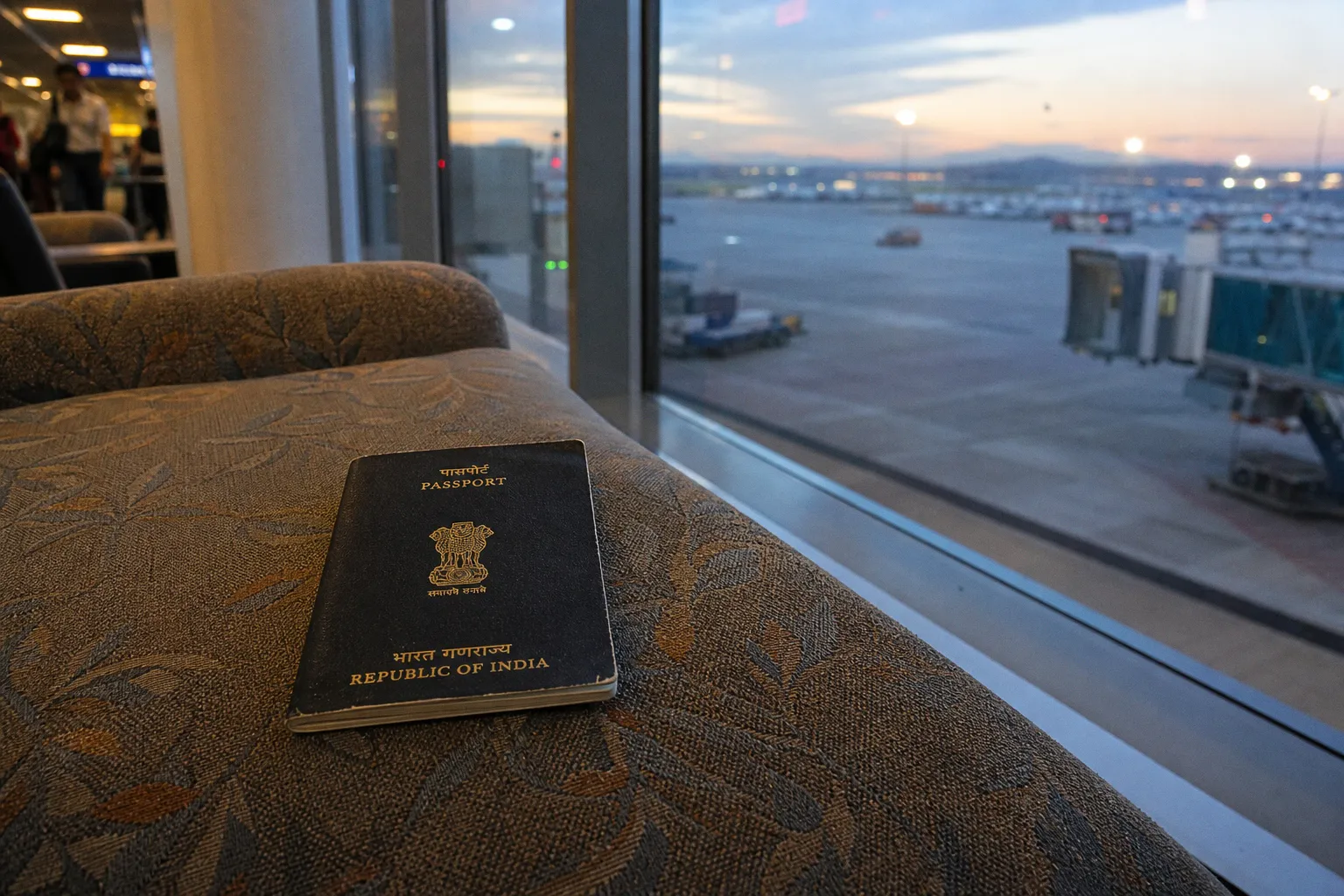
For anyone planning to fly between Indian cities during the same trip, that little booklet remains the only key that opens the boarding gate. The rule is short, the rule is non-negotiable, and the rule is the same from Delhi to Trivandrum.
Why Your Physical Passport Is the Only Way Through
For foreign nationals flying on domestic routes within India, a valid physical passport is the sole accepted photo identification. The Bureau of Civil Aviation Security (BCAS), which sets the rules every Indian airline follows, maintains a list of acceptable IDs — and that list was built around documents Indian residents carry. A foreign passport sits at the top of it. Nothing else a foreign traveler typically holds makes the cut.
The practical fallout is immediate. A photocopy won't pass. A scan on a phone won't pass. A driver's license from home, however valid it is on European or American roads, doesn't pass. The check-in agent and the security desk both want to see the original document, with the bearer's face beside it, in person.
Your passport isn't just your entry document. For every internal flight you take during your stay, it's also your boarding pass.
A few specifics that bite travelers who didn't plan for them:
- The passport must be valid at the time of travel. An expired passport, even one that expired the day before, is not accepted for boarding. Travelers whose documents are close to expiry should renew at home before departure rather than gamble on what Indian counters will accept.
- The name on the booking must match the passport exactly. Indian airline systems are stricter than many travelers assume. A booking under "Jon Smith" and a passport reading "Jonathan Smith" triggers an additional identity check at best, a denied boarding at worst. Reconciling names before arriving at the airport saves real time.
- Keep the passport in your carry-on, not checked baggage. Not because of theft concerns, but because ground staff may ask to inspect it multiple times: at check-in, at security, and occasionally at the gate. If it lives in a suitcase in the cargo hold, that suitcase has to come back out.
- A digital scan saved in email or a travel app is a backup, never a substitute. If the original is lost or stolen in India, the recovery path runs through a police FIR and the relevant embassy — workable, but slow and stressful.
Two Rulebooks at the Same Airport
One of the easier misunderstandings for first-time visitors is watching Indian passengers move through the same security checkpoint using a laminated card or a phone app. That's a route foreign travelers can't borrow. The ID rules for domestic flights split cleanly into two tracks, and the track that applies depends entirely on which passport you hold.
Indian citizens can use any of several government-issued photo IDs on the BCAS list. The accepted options include Aadhaar (the physical card, the eAadhaar PDF, the PVC version, or the mAadhaar profile), driving license, voter ID, PAN card, and government employee identity cards. Documents stored inside the official DigiLocker app are also recognized, so a phone carrying the right paperwork can serve as primary ID. Foreign travelers see a much shorter list.
| Traveler type | Accepted photo IDs for domestic Indian flights |
|---|---|
| Indian citizen | Aadhaar, driving license, voter ID, PAN, government employee ID, school photo ID (under 15) |
| Foreign national | Valid physical passport |
| NRI / OCI | Valid physical passport; OCI card is supplementary, not a substitute |
| Foreign-born child | Passport issued by their country of citizenship |
The asymmetry feels strange if you've just spent weeks watching Indians scan Aadhaar QR codes at metro turnstiles and airport gates. Different document, different system, different rulebook — and the rulebook that applies to a foreign visitor is the passport-only one.
Children Carry Less, but Always Carry Something
The strict passport rule softens considerably for the youngest travelers. Indian aviation rules treat anyone under the age of 15 as a child for ID purposes, and the document list shrinks with the age.
Children under 15 don't need a passport or any of the IDs adult Indians rely on. A school-issued photo ID — the kind the school itself prints — does the job. So does a birth certificate, which is the standard fallback when no school ID exists yet. Infants below the typical school-going age need a valid birth certificate. The point of the document is to confirm identity and parentage; the document doesn't have to be government-issued the way an adult ID does.
For mixed-nationality families — two foreign parents traveling with a child born abroad, say — the passport rule snaps back into place. The child travels on their own foreign passport, the same way the parents do. There's no school-ID shortcut for a child enrolled in a foreign school system, even when the original birth certificate travels alongside. The check-in counter reads it the same way it reads the parents' documents.
A practical note that often surprises families: these checks apply to the airline's relationship with the passenger, not to Indian immigration. Children don't clear immigration on a domestic flight, but the airline still verifies identity before issuing a boarding pass. The document trail starts the moment the family touches down in India and runs through the last internal flight before they leave.
DigiYatra Is Real, but Not Yet Your Shortcut
DigiYatra is the facial recognition system Indian airports have been rolling out over the past several years. Walk up to a gate, look at a camera, walk through. In theory, no document scan, no paper queue, no trail beyond the face on file.
In practice, the system as it stands runs on Aadhaar. Registering for DigiYatra requires an Aadhaar-linked Indian mobile number. That single requirement places the system out of reach for most foreign visitors, who generally don't hold Aadhaar. The same applies to overseas Indians returning home without an active Aadhaar record.
A few facts worth sitting with:
- DigiYatra is operational at 24 or more Indian airports, including Delhi, Mumbai, Bengaluru, Hyderabad, Chennai, and Kolkata.
- The system is voluntary, not mandatory. Manual document verification remains fully available at every DigiYatra-enabled airport, and no passenger is required to use the facial recognition flow.
- Biometric data is deleted within 24 hours of the flight's departure — a privacy protection baked into the system's design rather than added afterward.
- A passport-based DigiYatra enrolment for foreign nationals, NRIs, and OCI cardholders is in the rollout pipeline for 2026, intended to remove the Aadhaar-only barrier. The exact date when that enrolment will be functional at every DigiYatra airport across the country has not been finalized.
For travelers planning trips during the rest of 2026, the working assumption is straightforward. Register for DigiYatra if you hold Aadhaar and an Indian mobile number. Otherwise, skip it. The passport route remains the universal entry point.
Myths That Have Cost People Their Seats
Five myths surface over and over at Indian airport check-in counters. Each one has cost someone a flight they had already paid for.
"A photocopy is good enough." It isn't. The check-in agent verifies the document in the original. Photocopies are rejected outright. So are phone-screen photos. If the original is lost or stolen, the recovery path runs through an FIR at a local police station and emergency documentation from the relevant embassy — workable but never fast, and always more expensive than prevention.
"My embassy-issued consular ID works." It doesn't, on its own. Embassies issue identity letters to their own citizens for use within India, but those letters are not on the BCAS accepted list. The passport remains the only document recognized for boarding.
"DigiYatra is mandatory now for domestic passengers." It isn't. The system remains voluntary for every passenger category, including Indian citizens. Pilot programmes tied to international travel have been signposted for 2026, but no full mandate has been issued.
"Mismatched names on the booking and passport are fine." They aren't, and reconciling them on the spot is rarely possible. The booking has to be reissued before the passenger reaches the airport. Travelers who discover a mismatch a day before departure should call the airline or the booking platform first, not at the airport.
"My travel agent can pre-clear my ID." They can't. The document check happens in person, at check-in and again at security. No amount of pre-authorization from an agent bypasses the gate.
The Practical Playbook
For foreign travelers, the playbook on Indian domestic flights is short enough to fit on an index card and worth keeping in muscle memory.
The physical passport is non-negotiable throughout the entire trip — from immigration on arrival to the final departure out of the country, with every internal flight sitting in between. The passport must be valid at the time of each flight, and an expired booklet on the day of travel means no boarding pass, no exceptions. A scanned backup stored in email helps in the worst-case loss scenario, but it doesn't replace the physical document. Children's documents follow their own lighter rules, adults keep passports in hand, and check-in happens earlier than at many Western airports — budget at least 90 minutes at major hubs during normal traffic, more during festival windows.
The simplest rule on Indian domestic flights is also the most easily overlooked: while you're inside the country, your passport is your travel identity. Treat it that way, and the system rewards you. Take it for granted, and the gate will be happy to remind you.